All blog posts
Published on
20.05.2020
What is blended learning? And what benefits your company gets from it

Norma Demuro
E-Learning Expert, CEO @ keelearning
description

What is Blended Learning – This is a question you probably ask yourself when researching e-learning solutions. Let's explain the blended learning concept with a short vision. Imagine your employees are enthusiastic about learning, motivated, and full of energy to acquire new skills. Sounds utopian? Because most of the time, it's monotonous seminars where participants stare at PowerPoint slides for hours. Sometimes those are well-designed and engaging presentations, but nonetheless, it is just PowerPoint. Blended Learning aims to eliminate exactly that. It stands for the highest standards in learning content that efficiently imparts knowledge and inspires.
What is Blended Learning?
But let's start from the beginning. How do you define blended learning? Blended learning, often referred to as integrated or hybrid learning, is an educational concept that combines the strengths of face-to-face learning and e-learning. It "blends," so to speak, traditional and innovative learning concepts.
Why? Because face-to-face training still has its place, even if it is associated with higher costs than 100% e-learning solutions. Therefore, it is about linking traditional learning methods with modern digital technologies to create a flexible, efficient, and engaging learning environment. To better understand blended learning, it is helpful to look at the individual components more closely:
What is face-to-face learning?
Face-to-face learning refers to traditional forms of learning where instructors and learners come together at the same time and in the same place. Direct personal exchange is the focus. Advantages include the possibility of immediate clarification of questions, practical exercises under guidance, and the promotion of social skills through group work.
What is E-Learning?
E-learning is learning with electronic media online. Learners can access learning content regardless of time and place. E-learning includes a variety of formats such as web-based trainings, videos, podcasts, interactive exercises, and virtual classrooms. It enables self-directed learning and can be individually adapted to the needs of the learners.
The importance of Blended Learning
The importance of blended learning lies in combining the best of both worlds. Through this combination, one considers individual learning needs and effectively conveys learning content. Learners have the opportunity to work at their own pace while still benefiting from the exchange with instructors and other participants. The importance of blended learning is particularly evident in that it not only increases the motivation and engagement of learners but also sustainably improves learning success by addressing different learning styles and preferences.
The Blended Learning concept
The blended learning concept therefore includes different methods and learning media to optimize the learning process. But what does that look like in practice? A typical blended learning program could look like this:
Face-to-face events
Participants meet at regular intervals for in-person training. These sessions serve to deepen complex topics, conduct practical exercises, and enable direct exchange with instructors and other learners.
E-Learning phases
Between the face-to-face appointments, learners work on tasks via an online learning platform. They have access to multimedia learning materials such as videos, podcasts, and interactive exercises. Furthermore, they can ask questions in forums or chats and exchange ideas with others.
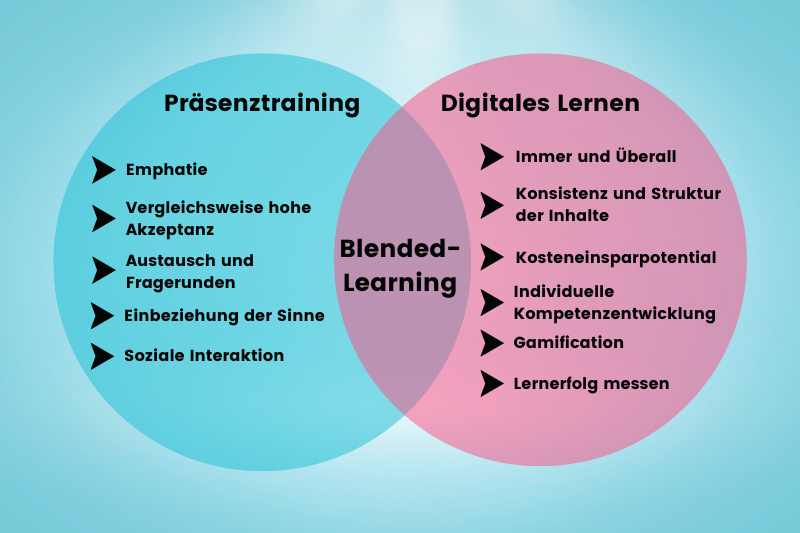
A Blended Learning example for a sales team
So far, so clear. But which topics are suitable for face-to-face events and which for e-learning units? In short: Any learning content that requires interpersonal interaction should primarily be conveyed in face-to-face events. Whereas theoretical content can be well conveyed in e-learning lessons.
Here is a practical blended learning example based on sales team training: Imagine a sales company that wants to train its employees in new sales techniques. First, the employees complete theoretical modules online, in which basics are taught.
This can include videos, texts, and small quizzes with our e-learning quiz app. After completing these modules, they meet for a face-to-face workshop, in which they apply what they have learned in role-plays and receive feedback from trainers. This interplay of theory and practice makes learning more effective and sustainable.
When does Blended Learning make sense?
Not every learning content is equally suitable for blended learning. Therefore, we present a checklist here of when blended learning is particularly useful.
- Complex subject areas:
When it comes to conveying complex content, blended learning allows for flexible adaptation to individual learning needs. - Geographically distributed teams:
In companies with different locations, blended learning facilitates the training of all employees without high travel and accommodation costs. - Temporal flexibility:
Employees with different working hours or who work part-time learn when it fits them best, thanks to the online components.
This is a "general" checklist. But what specific use cases and learning contents are suitable?
Onboarding new employees
Basic information about the company, guidelines, and processes can be conveyed online, while personal meetings are used for team building and cultural integration.
Product and sales training
Theoretical knowledge about new products or services can be easily learned online. In face-to-face events, sales techniques can be practiced practically and feedback can be obtained from trainers.
Leadership training
Leadership theories and models can be provided as an e-learning module. Workshops then offer space for exchanging experiences and role-plays.
Technical training
Operating instructions or software tutorials can be displayed excellently online. Practical applications and troubleshooting can be trained in person but could also be handled entirely online.
Language courses
Vocabulary and grammar rules can be learned online. Oral communication is practiced in personal meetings.
Compliance and safety
Legal regulations and safety guidelines can be conveyed via e-learning. Face-to-face events can be used as a supplement for practical exercises and simulations.
Project management training
Theoretical foundations are worked out online. Concrete projects are then planned and methods are applied in workshops.
Soft skills training
Topics such as time management, communication, or conflict resolution are introduced through interactive online modules and further deepened in person through group exercises.
E-Learning vs. face-to-face learning
It is therefore very clear that both forms of learning have their specific advantages. In the following, we clearly contrast the most important characteristics of both methods.
E-Learning
- Flexibility: Learning regardless of place and time.
- Self-directed learning: Adaptation to individual learning pace.
- Interactive content: Use of videos, animations, and quizzes.
- Cost efficiency: Reduced travel costs and less downtime.
- Scalability: Easy addition of participants without logistical extra effort.
Face-to-face learning
- Direct interaction: Personal exchange with instructors and other learners
- Immediate feedback: Questions can be clarified directly.
- Practical exercises: Conducting role-plays and group work
- Networking: Building personal relationships and team spirit
- Structured process: A fixed schedule can promote discipline.
While e-learning scores with its flexibility and cost efficiency, face-to-face learning is characterized by direct exchange and practical experience. The optimal learning strategy depends on individual preferences and the specific requirements of the learning content. Often, a combination of both approaches, such as in blended learning, can be the most effective solution to ensure both flexibility and personal contact.
The advantages of Blended Learning
What blended learning is and how it connects face-to-face learning and e-learning is now clear. Let's take a concrete look at the advantages of this form of learning:
- More effective conveyance of learning content:
Through the combination of online and face-to-face phases, content can be conveyed more effectively. Theory can be learned online, while face-to-face time is used for practice and deepening. - Cost and time savings:
Fewer face-to-face times mean lower travel and accommodation costs. Furthermore, learning content is updated and distributed faster without the time-consuming planning of seminars. - Flexibility:
Learners design the online phases according to their own schedule. This allows for better compatibility of work, family, and further education. - Individual learning pace:
Learners work at their own pace. Learning content can be repeated and deepened if there is a need. - Up-to-date learning content:
Digital media enable a quick update of learning materials. Thus, knowledge always stays up to date. - Measurable learning success:
Through e-learning tools, progress and learning success can be tracked precisely. Companies see who has already completed which modules and where there might still be a need. - Motivation and engagement:
The variety between different learning methods keeps motivation high. Interactive content and multimedia preparation appeal to different learning types.
How companies benefit from Blended Learning
With the introduction of blended learning, you will experience noticeable changes in your company. Training becomes more efficient and tailored, which saves time and resources. Your employees access learning content more flexibly and integrate it better into their everyday work life. This not only increases employee satisfaction but also motivation in the team. Furthermore, blended learning promotes a culture of self-responsible learning and innovation: two things that make your company future-proof. Your company becomes more agile, reacts faster to market changes, and becomes overall more attractive for current and potential employees.
A modern training offer shows that your company invests in its employees and values their development. Employees feel valued and are more motivated. This is a decisive advantage in the competition for skilled workers.
This will change in your company through Blended Learning
With blended learning, you design the training in your company to be more efficient and contemporary. Your employees can comfortably learn basic content online and use valuable face-to-face time for questions and practical applications. This hybrid learning concept leads to better learning results in less time and increases the effectiveness of your training measures.
Another advantage is the reduction of downtime in day-to-day business. Since your employees have to spend less time in face-to-face seminars, they can organize their work tasks more flexibly. Online learning can be seamlessly integrated into everyday work, which increases productivity and optimizes the workflow.
The flexibility of blended learning contributes significantly to higher satisfaction among your employees. They appreciate the possibility of learning at their own pace and combining further education with their individual life circumstances. This strengthens loyalty to your company and promotes a positive working climate.
Furthermore, you benefit from better scalability of your training programs. New employees can be integrated quickly and easily into existing training, which is particularly advantageous in growth phases. You save resources and simultaneously ensure a uniform knowledge base within your team.
Blended Learning for your company
With keelearning, you have a reliable partner by your side who seamlessly connects face-to-face training and online learning content. This (and more) is what keelearning offers you:
- Ideal for non-desk workers: Flexible access via voucher and app in the store.
- Efficient tag structure: Content can be made accessible to different target groups and individuals.
- Outstanding usability in the admin area: Simple operation without much training, immediate start possible.
- High data protection standard: Our server location is Germany.
- Excellent user-friendliness: easy to operate, short training time.
- Fast translation with autotranslate: Content can be translated into over 20 languages.
- Excellent customer support: reliable and personal
- Clean visual appearance: Innovative and "tidy" user interface
With us, you design the learning process not only efficiently but also excitingly and motivatingly. Thanks to real-time feedback, you track the progress of your employees directly and adjust training content immediately if necessary. The mixture of e-learning and face-to-face teaching deepens knowledge and makes it possible to apply what has been learned in practice – for sustainable successes that really bring your team forward.
Are you ready for innovative and efficient learning solutions? Book a free demo call with our experts now!
Table of Contents
Ready for training that works?
Get to know keelearning in a personal demo – no obligation and tailored to your needs.
Share
Lorem ipsum dolor sit amet, consectetur adipiscing elit. Suspendisse varius enim in eros elementum tristique. Duis cursus, mi quis viverra ornare, eros dolor interdum nulla, ut commodo diam libero vitae erat. Aenean faucibus nibh et justo cursus id rutrum lorem imperdiet. Nunc ut sem vitae risus tristique posuere.





The learning platform for businesses looking to make their training simple, mobile, and accessible to all – with no IT overhead.