All blog posts
Published on
Building Corporate E-Learning: A 7-Step Roadmap

Lisa Kubatzki
Senior Content Marketing Manager @ keelearning
description

A single online course does not make an e-learning program. An LMS alone does not change a learning culture. Digital learning only becomes truly effective when goals, content, platform, responsibilities, and performance measurement are all aligned.
Small and medium-sized enterprises in particular often start pragmatically: a mandatory training session is digitized, an onboarding course is created, or a tool is tested. That is a good start. But as soon as multiple target groups, locations, topics, and certification requirements are added, e-learning needs structure.
Building e-learning in a company therefore means more than just introducing software. It means creating a sustainable learning system: with clear learning objectives, relevant content, reliable processes, and a platform that makes professional development scalable in the long term.
In this article, you will learn how to build e-learning in your company step by step, which resources you should plan for, and which mistakes you should avoid.
{{key-takeaways}}
What does it mean to build e-learning in a company?
Building e-learning in a company means systematically planning, implementing, and developing digital professional training. It is not just about making existing in-person training available online.
A sustainable e-learning program answers fundamental questions:
- What learning objectives is the company pursuing?
- Which target groups need which content?
- Which training courses must be mandatorily documented?
- Which content does the company create itself?
- Which courses are purchased or used from a library?
- Which platform handles learning paths, certifications, and reporting?
- How is learning success measured?
The difference compared to a one-off tool implementation is crucial. A tool provides functions. An e-learning program connects these functions with strategy, didactics, content, and processes.
The existing article Successfully introducing e-learning in companies focuses primarily on which roles are involved in the implementation. This article takes a different perspective: the concrete roadmap from needs analysis to ongoing development.
Why a structured approach is crucial
Without structure, e-learning quickly grows out of control. Individual teams create courses, content is scattered across different locations, records are missing, and no one knows exactly which training programs are actually effective.
A structured approach prevents these disconnects. It ensures that digital professional development contributes to company goals from the very beginning. Employees receive relevant content, managers maintain an overview, and HR or L&D can manage training in a measurable way.
A clear framework is particularly beneficial for companies with operational teams, shift work, multiple locations, or high turnover. In these environments, content must be quickly accessible, easy to understand, and available on mobile devices.
Read more in our article E-Learning for Firstline Workers.
The Roadmap: Building Corporate E-Learning in 7 Steps
Step 1: Conduct a needs analysis
Don't start with the software. Start with the need.
Ask yourself: What problems should e-learning solve? Is it about faster onboarding, fewer in-person meetings, better mandatory training, product training, knowledge retention, or customer training?
Gather information from HR, management, specialized departments, support, compliance, and operational teams. Recurring questions, frequent errors, long onboarding times, or training topics that require significant organizational effort are particularly valuable insights.
A good needs analysis identifies:
- Which target groups need to be trained
- What content already exists
- Which topics are missing
- Which training sessions are mandatory
- Which formats are currently not working
- Which key performance indicators should be improved
This creates the foundation for an e-learning program that solves real problems.
Step 2: Define goals and KPIs
E-learning requires measurable goals. Without clear objectives, it remains unclear whether the effort, budget, and platform are worth it.
Possible goals include:
- Reducing onboarding time
- Completing mandatory training on time
- Reducing support effort
- Communicating product knowledge faster
- Increasing transparency regarding knowledge levels
- Reaching employees across all locations
- Lowering training costs
- Making learning success measurable
Derive appropriate KPIs from these goals. These include completion rates, pass rates, learning time, retakes, feedback, mobile content usage, or a reduction in support queries.
With analytics and reporting , managers can keep track of learning progress, knowledge gaps, and training success.
Step 3: Develop a content strategy
Content determines whether e-learning is adopted. A good program needs more than just long videos or PDF uploads.
Determine which content you will create yourself, which you will adopt from templates, and which topics departments will contribute. Prioritize your content:
Digital content should be modular. Short learning units, quizzes, practical examples, and reviews are more effective than large blocks of information.
The authoring tool helps companies transform their own content into structured digital courses. In addition, this article provides Creating e-learning content practical tips for preparing learning materials.
Step 4: Choose the right software
The right software provides the technical foundation for your learning program. Therefore, don't just check if a tool "can do courses." What matters is whether it fits your goals, target audiences, and processes.
Key selection criteria include:
- ease of use for learners and admins
- mobile accessibility
- authoring tool for custom content
- course library and templates
- learning paths and automated assignments
- roles, groups, or tags
- proof of completion and certificates
- reporting and analytics
- multilingual support
- communication and feedback
- integrations with existing systems
For companies with many operational employees, mobile accessibility is particularly important. Those without fixed PC workstations need learning content via an app or a mobile-optimized platform.
There are various solutions on the market for different requirements. Well-known e-learning and LMS providers include, for example, Moodle, TalentLMS, 360Learning and keelearning. While some systems focus on traditional learning management or course delivery, keelearning combines an LMS, authoring tool, course library, mobile app, learning paths, and reporting into a single platform. Therefore, the deciding factor in your choice is not just the range of features, but how well a solution fits your specific target groups, content, and internal processes.
The digital employee training from keelearning combines an LMS, mobile app, learning paths, reporting, and interactive course formats in one platform.
Step 5: Start a pilot phase
Do not roll out e-learning across the entire company immediately. Start with a clearly defined pilot project.
Topics with high utility and a manageable scope are suitable, for example:
- Onboarding new employees
- a mandatory training session
- Product training for a team
- Safety training for a specific location
- short knowledge checks for operational teams
Define in advance what the pilot is intended to demonstrate. Then, evaluate: Are employees using the course? Do they understand the content? Is the platform working correctly? What questions are coming up? Where are learners dropping off?
A pilot phase provides valuable insights before you roll out e-learning company-wide.
Step 6: Planning the company-wide rollout
The pilot is followed by the rollout. This step determines whether e-learning becomes an integral part of the daily work routine.
Communicate clearly:
- Why is e-learning being introduced?
- What are the benefits for employees?
- Which training courses are mandatory?
- How much time is allocated?
- Where can learners find support?
Managers play a key role in this. They free up time, explain the benefits, and make learning visible within the team. Without support from the departments, e-learning quickly remains just an HR initiative.
Also, plan your internal communication. News, short videos, team meetings, or app notifications make the launch more visible. You can find suggestions for this in the article Internal communication tools.
Step 7: Measuring success and continuous development
E-learning is not a one-time project. Content, target groups, and requirements change. That is why every program requires regular evaluation.
Do not just check completion rates. Also look at:
- Test results
- Learner feedback
- Commonly incorrect answers
- Drop-off points
- Usage of learning paths
- Follow-up questions after training
- Application in daily work
- Identifying knowledge gaps
This data shows which content needs improvement. Perhaps a course is too long. Perhaps a practical example is missing. Perhaps a target group needs different learning paths.
E-learning becomes more effective when companies maintain it continuously.
What resources do companies need for e-learning?
Resource requirements depend on the scope, target groups, and existing content. Nevertheless, companies should realistically plan for three areas.
Time
A small pilot project can be implemented much faster than a company-wide learning program. Factor in time for analysis, content creation, tool configuration, testing, communication, and evaluation.
The key is that the effort decreases once structures are in place. Reusable templates, existing learning paths, and a central course library accelerate future projects.
Budget
Budget is not just about software licenses. Also consider content creation, internal working hours, potential translations, administrator training, and communication.
The article E-learning costs shows which cost factors typically play a role in digital professional development.
Personnel
E-learning requires clear accountability. Depending on the size of the company, a small core team from HR, L&D, and a specialist department is sufficient. It is important that subject matter expertise, didactic structure, and technical administration come together.
Subject matter experts provide content. L&D structures the learning process. Managers ensure application in daily work.
Typical pitfalls when setting up e-learning
Focusing too much on the tool
Software cannot fix unclear goals. Define your needs, target audiences, and learning objectives first. Only then should you choose your platform.
Digitizing too much content at once
Start with a clear focus. One effective pilot project is worth more than 30 unfinished courses that lack structure.
Failing to involve employees
E-learning fails when it is disconnected from the daily workflow. Gather feedback from learners, especially those in operational teams.
Not scheduling time for learning
Digital training requires dedicated learning time. If learning is treated as something to be done "on the side," participation rates will drop.
Measuring success solely by completion rates
Completing a course does not prove that learning has occurred. Combine completion data with knowledge checks, feedback, and real-world application.
How keelearning helps you build an e-learning program
keelearning helps companies build structured digital learning programs and manage them for the long term. The platform combines an LMS, authoring tool, course library, mobile app, learning paths, communication, and reporting.
Especially during the initial phase, customers are not left to navigate the platform alone. Our Customer Success team provides intensive support during implementation, helping companies tailor the platform to their specific requirements. This includes structuring target groups and learning paths, setting up initial content, and preparing for the rollout. The result is a solution that not only works technically but also aligns perfectly with the company's specific training strategy from day one.
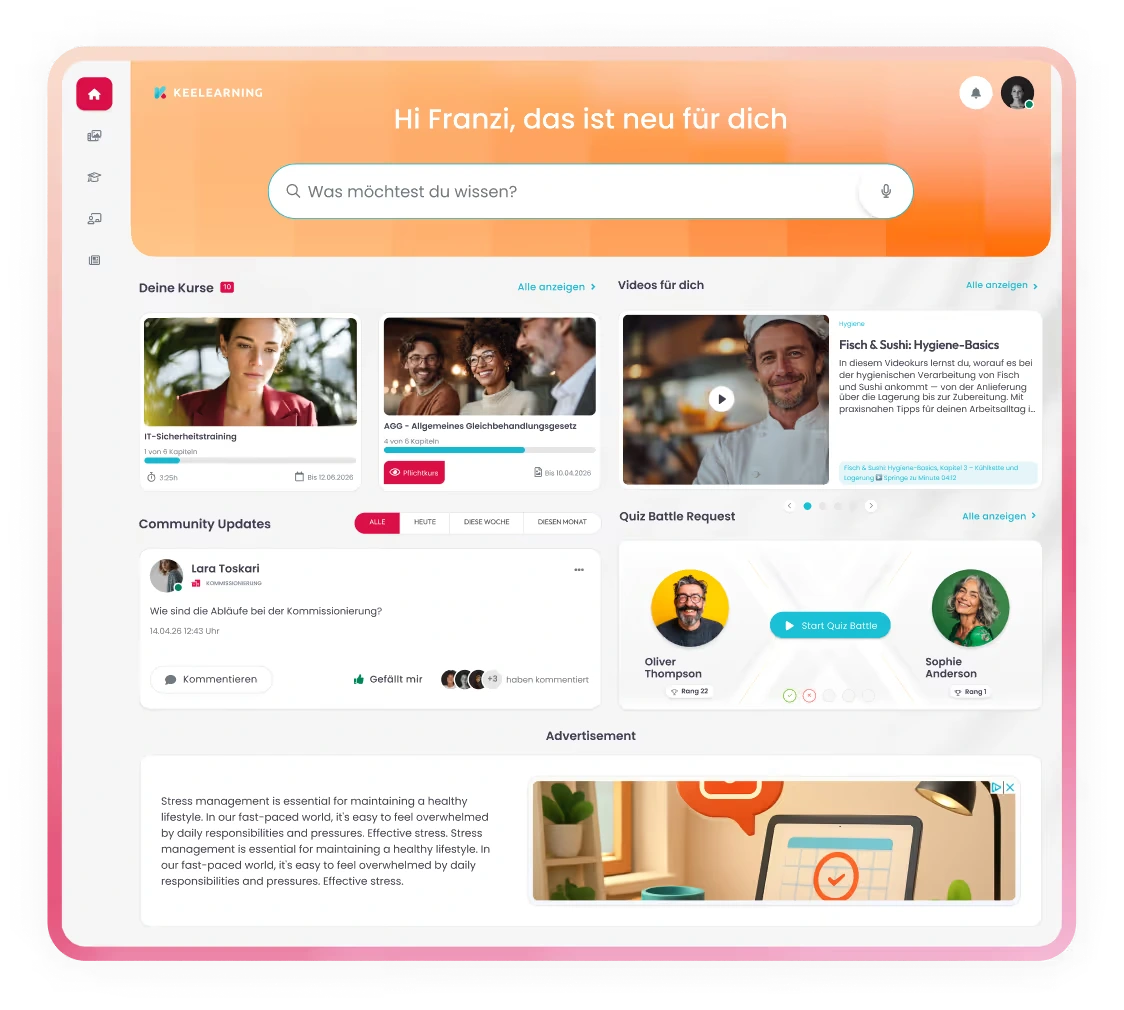
Companies can create their own courses using the authoring tool. The course library and templates provide ready-made content for recurring training topics. Roles, tags, and learning paths control which target groups receive which content.
The mobile app makes learning flexibly accessible for operational teams. Quizzes, gamification, and knowledge checks engage learners and make progress visible. Reporting shows which training sessions have been completed and where knowledge gaps still exist.
keelearning becomes especially valuable when companies stop viewing e-learning in isolation and instead integrate it with knowledge management. You can find the basics on this in our article Building Knowledge Management.
keelearning also shares practical insights into digital professional development and modern learning strategies on LinkedIn.
E-learning requires structure, not just software
Building corporate e-learning is not just an IT project or a one-off course production. It is a strategic process: understanding needs, defining goals, structuring content, selecting software, testing, rolling out, and continuously improving.
Those who follow this roadmap consistently create a learning program that truly reaches employees and provides long-term relief for the company. Professional development becomes more predictable, knowledge remains accessible, and training becomes measurable.
keelearning supports this development with a platform that combines course creation, learning paths, mobile access, reporting, and knowledge management.
{{inline-cta}}
FAQ: Building corporate e-learning
How do you build e-learning in a company?
Start with a needs analysis, define goals and KPIs, develop a content strategy, select the right software, run a pilot test, plan the rollout, and measure success regularly.
What is the difference between introducing e-learning and building e-learning?
Introducing e-learning often refers to starting with a tool or initial courses. Building e-learning means developing a sustainable program with strategy, content, processes, responsibilities, and success measurement.
What software is needed for corporate e-learning?
Companies need a learning platform or LMS that fits their target groups and processes. Examples include Moodle, TalentLMS, 360Learning, and keelearning. Important features include an authoring tool, learning paths, mobile access, reporting, and course management. keelearning bundles these features into one platform and could therefore be the right software for you.
Which content is suitable for getting started?
Topics with high demand and clear impact are suitable, such as onboarding, mandatory training, workplace safety, product training, or recurring questions from everyday work.
How do you measure the success of e-learning?
Key metrics include completion rates, test results, learning time, feedback, drop-off points, retake attempts, usage of learning paths, and the application of learned skills in daily work.
Key Takeaways
- Building e-learning means developing a structured learning program, not just introducing a tool.
- The process includes needs analysis, goal definition, content strategy, software selection, pilot phase, rollout, and success measurement.
- Clear responsibilities, realistic resources, and a focus on the company's actual learning needs are particularly important.
- Digital training works better when content is modular, mobile-friendly, easy to understand, and measurable.
- keelearning supports companies in building a sustainable e-learning program with an LMS, authoring tool, course library, learning paths, reporting, and a mobile app.
Table of Contents
Ready for training that works?
Get to know keelearning in a personal demo – no obligation and tailored to your needs.
Share
Lorem ipsum dolor sit amet, consectetur adipiscing elit. Suspendisse varius enim in eros elementum tristique. Duis cursus, mi quis viverra ornare, eros dolor interdum nulla, ut commodo diam libero vitae erat. Aenean faucibus nibh et justo cursus id rutrum lorem imperdiet. Nunc ut sem vitae risus tristique posuere.





The learning platform for businesses looking to make their training simple, mobile, and accessible to all – with no IT overhead.