All blog posts
Published on
20.09.2023
E-Learning for firstline workers - 6 surprising practical examples

Norma Demuro
E-Learning Expert, CEO @ keelearning
description

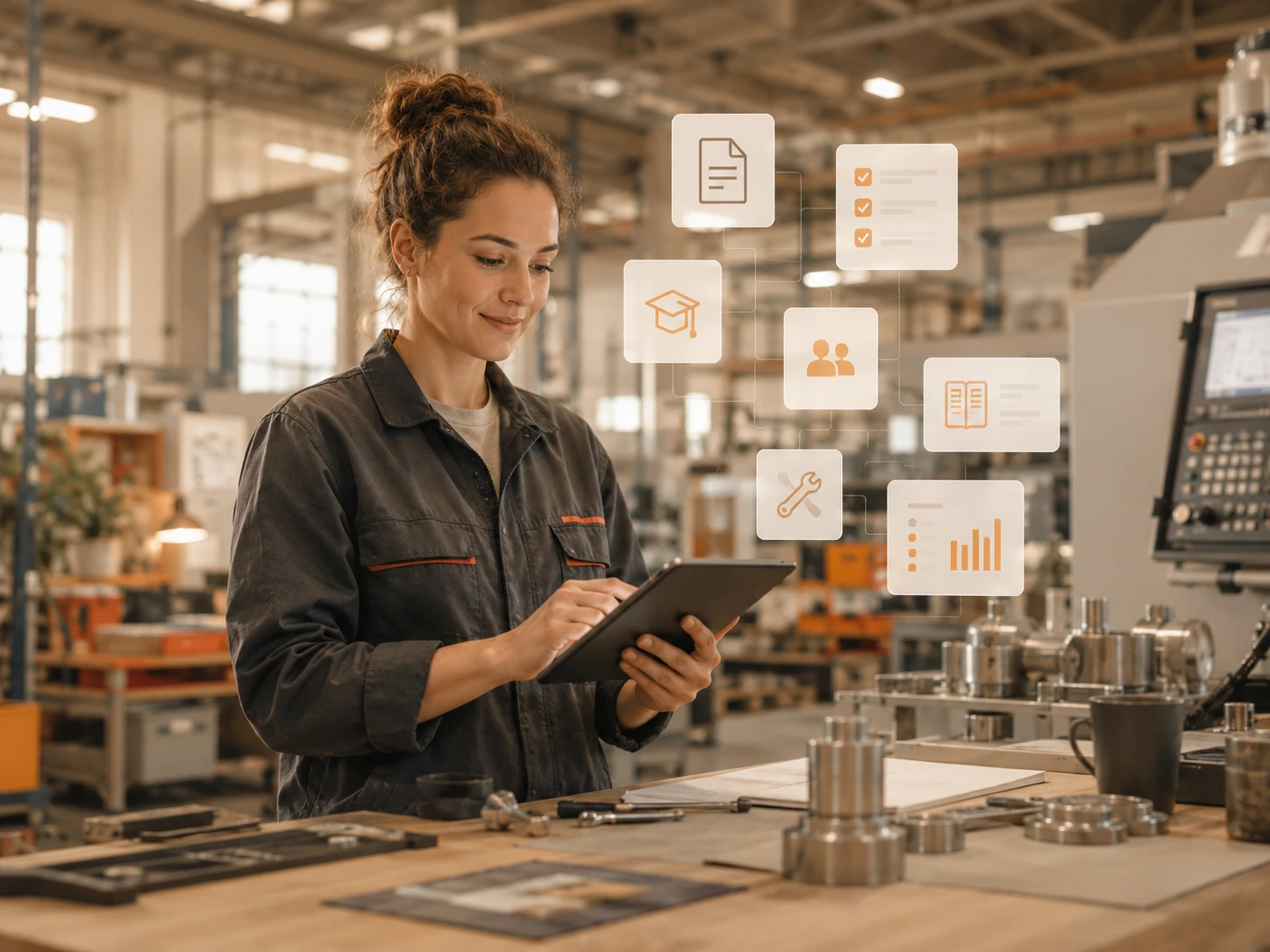
E-learning for firstline workers is particularly efficient. This is because it offers opportunities for further education away from the office desk. In this blog article, we present 6 practical examples that might surprise you. Because in some industries, digital learning is still not established, even though it brings numerous advantages with it.
Efficient e-learning for firstline workers
The term "firstline worker" encompasses all professions that do not necessarily require a desk job. Some examples include florists, skilled tradespeople, mechanics, cashiers, or bakers – they work directly with the product or the clientele. However, many forms of e-learning or traditional training formats are designed for jobs with a desk.
However, continuing education is not a topic reserved for office workers. On the contrary: Especially nowadays, it is important to offer firstline employees numerous opportunities for further education. Because in this group of employees, turnover is particularly high. E-learning for firstline workers is an exciting way to reach employees in their everyday work life.
Well-trained teams in the catering industry
Satisfied guests are no coincidence. Experienced restaurateurs know that the key to success lies in a competent team. For this reason, staff should be continuously trained. Nowadays, this is possible digitally, remotely, and even multilingually. With a suitable learning app, helpful content is conveyed. Whether cutting, polishing, or presentation techniques – basic knowledge and new trends should not pass catering staff by without a trace.
More than a green thumb for landscape gardeners
A green thumb and enthusiasm for nature are good prerequisites for landscape gardeners. But the trade must be learned. Since landscape gardeners mostly work outdoors, classic training courses and seminars mean extra effort. In contrast, digital forms of learning are much easier to integrate into everyday work life. Through varied and practical e-learning content, further education happens "on the side" and yet (or perhaps precisely because of it!) extremely efficiently.
Intuitive learning apps for the beauty industry
The beauty industry is known for rapid changes and new trends. E-learning content is ideally suited for the further education of hairdressers, beauticians, and the like. Because they are easy to update and can even be created by experienced employees themselves. Staying on the pulse of time in the beauty industry is only achieved by those studios that prioritize the further education of their team.
Efficient onboarding for florists
Training new employees is cost and time-intensive. Usually, special training days or meetings are organized. Digital and, above all, mobile solutions for onboarding offer a lean alternative. Because participation in this form of training takes place very flexibly. New team members can learn from anywhere, e.g., at home, to prepare for the next working day.
The example of a large flower retailer shows how digital onboarding for florists not only saves time and money but actually brings the team closer together and reduces the resignation rate.
E-learning in the construction industry
No room for e-learning on the construction site? Wrong. Because mobile and digital solutions, in particular, are ideal in the construction industry. Helpful content can be easily accessed via smartphone and is even automatically translated into the preferred learning language thanks to a multilingualism tool. Whether it is material science, safety instructions, or work processes – digital learning forms make knowledge easily consumable.
Mobile-first in the hotel industry
Technological innovations are bringing further education into the everyday work life of hotel employees. Through an efficiently designed learning app, digital learning becomes smart, practical, and even entertaining. At the center of innovative learning approaches is always the employee with their current challenges. For example, work processes can be documented transparently or mandatory training simplified. The "mobile-first" approach allows teams to access learning content quickly and barrier-free via smartphone or tablet.
Conclusion: E-learning for firstline workers
This blog article shows digital learning in practice. In many industries, new technologies are finding their way in. Yet, they seem to stop before reaching further education. And yet, learning software for firstline workers is extremely effective when it comes to imparting knowledge. Through it, skills are developed in teams, knowledge gaps closed, and valuable time saved during training. Would you also like to reliably digitize your team's further education? Our experts will be happy to show you the possibilities of e-learning for firstline workers in a non-binding conversation.
Table of Contents
Ready for training that works?
Get to know keelearning in a personal demo – no obligation and tailored to your needs.
Share
Lorem ipsum dolor sit amet, consectetur adipiscing elit. Suspendisse varius enim in eros elementum tristique. Duis cursus, mi quis viverra ornare, eros dolor interdum nulla, ut commodo diam libero vitae erat. Aenean faucibus nibh et justo cursus id rutrum lorem imperdiet. Nunc ut sem vitae risus tristique posuere.




The learning platform for businesses looking to make their training simple, mobile, and accessible to all – with no IT overhead.