All blog posts
Published on
04.01.2024
LXP: The Learning Experience Platform compared to an LMS

Norma Demuro
E-Learning Expert, CEO @ keelearning
description

LXP stands for "Learning Experience Platform." But what can an LXP do compared to a classic LMS (= Learning Management System)? The short answer is: It is more efficient and motivates learners better. We explain exactly how this is achieved and where the biggest differences between LXP and LMS lie here.
Users consume content differently today
User behavior has changed significantly in recent years: Social media, Netflix, and the like ensure that users consume content differently. It is clear that demands have changed drastically. Content – including learning content (!) – must be easy and entertaining to consume.
Everyone is aware that there is a real flood of information. Data analysis is used to deliver content more specifically. For example, content is displayed based on interests and user behavior. The situation is similar with learning content on an LXP. Because every learner brings different prior knowledge – and thus different demands. Learners do not always know themselves what learning level they are at. This is exactly where a Learning Experience Platform comes in.
What is a Learning Experience Platform (LXP)?
Let's start at the beginning: What is an LXP? A Learning Experience Platform (LXP) puts the user at the center. How does it do that? Mostly through data analysis. Because it uses this to offer personalized learning experiences. It draws up its own learning paths that send the user on a particularly efficient "learning journey." In addition, it integrates various resources such as videos, articles, and podcasts, thereby creating an interactive and engaging learning environment.
What is the difference between an LXP and an LMS?
Although both systems convey knowledge content, there are significant differences between LXP and LMS. Here are the three biggest differences.
Still looking for an LMS? Then check out our comparison of LMS systems!
Focus on learners vs. focus on administration
An LMS is primarily an administrative tool for administrators to create and assign courses and track progress. An LXP, on the other hand, puts the learner at the center and promotes independent and self-directed learning.
Classic vs. innovative learning content
An LMS usually offers fixed courses and content, whereas LXP offers access to a wide range of resources. Whether interactive learning content or user-generated content: LXP relies on innovative content.
Personalization
LXPs use artificial intelligence to provide personalized recommendations, while LMSs follow a "one size fits all" approach. Furthermore, interaction and engagement are promoted by LXP. For example, they offer social learning, while LMSs only support these functions to a limited extent.
3 key functions of an LXP
As already mentioned in the last paragraphs, LXP is not just a "buzzword" but actually offers new functionalities. Here are the three key functions of an LXP:
- Personalized learning paths through AI:
The platform analyzes user behavior and preferences to provide tailored learning recommendations. - Social learning and collaboration:
Functions like forums, chats, and peer reviews promote exchange and collaborative learning. - Versatile content integration:
In addition to traditional courses, an LXP integrates various formats such as videos, podcasts, articles, and enables the inclusion of external content.
Creating fun and success experiences thanks to LXP
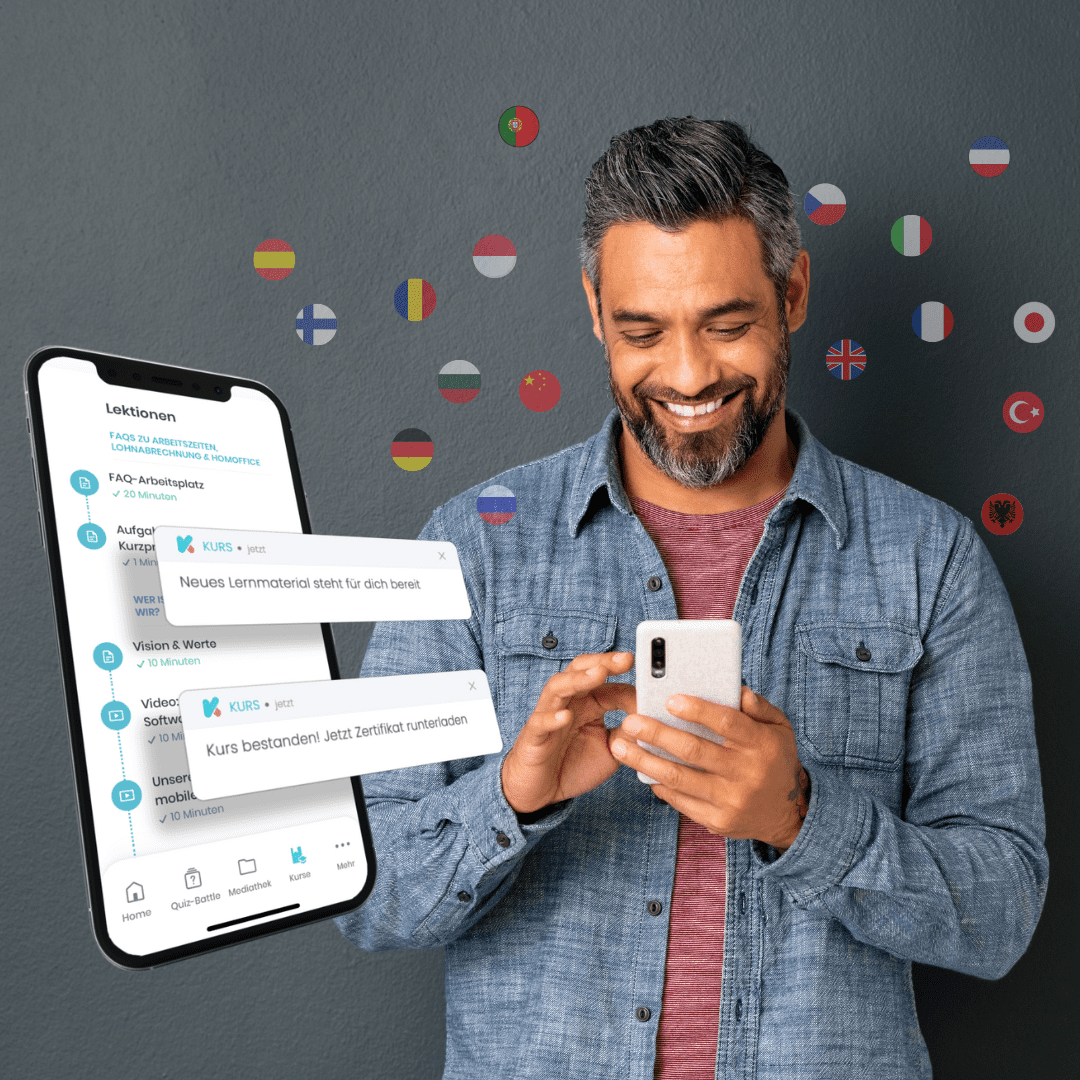
Based on completed tests and the user's learning behavior, an LXP recognizes where they stand. This allows it to identify which content is subsequently particularly suitable for learners in the next step. Maximum learning success is guaranteed through logical learning paths.
During the learning process, users receive varied content such as videos, web-based trainings, or microcontent. The social aspect cannot be missing in a Learning Experience Platform: Learners interact with each other via quiz duels or chats.
Experiences of success are very important. Whether it's motivation through the statistics function or recognition through a completion certificate: A Learning Experience Platform offers numerous possibilities.
Difference between LMS and LXP - Advantages at a glance
The differences between LMS and LXP should now be clear. But what advantages result from these differences? Here you will find some of the numerous advantages listed:
- Personalized content recommendation
- Faster learning progress through individual learning paths
- Intuitive and user-friendly learning environment
- Varied content design
- Centralized knowledge management: Everything in one place
- Mobile learning: Usable anytime and anywhere
- Blended learning: Suitable as a supplement to analog learning
- Social learning: Promotion of interaction and motivation
- Gamification: High fun factor through a playful approach
- Microlearning: Effectiveness through small learning units
- Simple editorial system and statistics at a glance
- Certificates and other learning incentives
We would like to go into one point in more detail here: Gamification. Because this is mentioned by a particularly large number of learners as the greatest relief in the learning process. It involves the playful conveyance of learning content. In the following, we will show you how gamification is used at keelearning and thus efficiently supports companies in the onboarding and further training of employees.
Increasing motivation through interactive quiz apps
Whether it concerns safety training, hygiene regulations, data protection guidelines, specific technical topics, or product knowledge – every company has important learning content to convey. This applies to sales just as much as to human resources, to academies just as much as to companies. With the keelearning quiz app, you can motivate seminar participants and employees in an innovative way. Position yourself as an attractive employer or modern educational institution by making learning interactive and engaging.
Flexible learning for all industries and departments
Our quiz solutions are versatile – whether for field service, for employee qualification in the healthcare sector, or for the development of specialists with advanced knowledge. The industry does not matter. We also create expert quizzes to specifically deepen specific knowledge. As an additional bonus, sweepstakes can be integrated into the quiz to win new prospects for your products or to strengthen customer loyalty.
So much for the concrete application of gamification in an LXP. But what do the technical requirements for this look like?
LXP: Technical further developments required
Are you interested in the technical aspects of LXP? Then read on now. In addition to the further development of content between LMS and LXP, technical innovations are also in focus. After all, communication between the system and the learning content must be guaranteed. The Experience API (abbreviated: xAPI) sends information to the database, which is called the Learning Record Store (LRS). In this LRS, all learning activities are saved, processed, and forwarded accordingly.
API is the language used to communicate with the database. The xAPI is therefore a further development of the probably somewhat better-known SCORM, which, however, reaches its limits in times of LXP.
LXP in practice
You now know the essential differences between LMS and LXP, the essential functionalities of LXP, as well as the technical conditions. But what does the use of an LXP really mean in practice? Let us show you this using a fictional (even if not invented 😉) example.
Think of a rapidly growing manufacturing company that operates spread across several locations in the German-speaking region. Due to expansion, many new employees must be onboarded simultaneously. In-person training is logistically complex and costly due to the various locations. In addition, the different prior knowledge of the employees leads to inefficiencies: what is boring for one overwhelms another. The company decides to implement a Learning Experience Platform to optimize onboarding and further training.
They focus on four main areas:
- Personalized onboarding paths:
New employees receive individually tailored learning modules based on their role and prior experience. - Interactive content:
Use of videos, simulations, and quizzes increases engagement. - Social learning:
Employees can exchange ideas in forums, ask questions, and share best practices. - Mobile access:
Through the mobile app, everyone can also learn on the go.
The management hoped that the solution would allow them to continue to grow rapidly without "getting lost" in logistical problems and thus having to accept a damper on growth. But the results were surprising – in the most positive sense! Here are the results summarized briefly:
The results
- 40% reduction in onboarding time: New employees are productive faster.
- 25% cost savings: Less expenditure on travel costs and external trainers.
- Increased employee satisfaction: Positive feedback on the learning offer and flexibility.
- Improved performance: Through continuous further training, the quality of work and innovative capacity increase.
The use of the LXP enabled the company to master the challenges of rapid growth. The personalized and flexible learning offers led to more efficient processes, cost savings, and stronger employee loyalty to the company. At the same time, a culture of continuous learning was established, which equips the company for future challenges.
LXP = Win-win for learners and companies
LXPs offer advantages for learners and companies alike. Instead of seeing e-learning for companies as simple "online courses," the transformative meaning should be clear. E-learning solutions can sustainably transform companies. LXPs stand not only for technological progress but also for new approaches to collaboration.
The advantages for companies
By using an LXP, companies significantly shorten the onboarding time of new employees. This is because personalized learning paths enable new team members to become productive faster. Furthermore, continuous further training keeps the workforce up to date, which leads to better business results.
Cost savings
LXPs reduce the need for in-person seminars and external trainers, which leads to significant cost savings. In addition, learning content can be easily updated and made available to a large number of employees without incurring additional costs.
Data-driven decisions
Through extensive analysis and reporting functions, companies gain valuable insights into the learning progress of their employees. This allows knowledge gaps to be identified early on and training programs to be specifically optimized.
Promoting a learning culture
A culture of continuous learning promotes innovation and growth in the company. Those who invest early and continuously in the development of the team save money in the long term. This is because well-trained employees are more likely to remain loyal to the company than those who are left to their own devices. This lowers turnover and leads to a more stable and successful business in the long term.
The advantages for employees
But what about the advantages for employees? After all, it is not just about onboarding them faster and letting them learn efficiently. It is also about imparting long-term skills that make them "highly skilled" employees and preparing them for their further career path.
Personalized learning experiences
Employees benefit from individually tailored learning paths that are cut to their personal needs and career goals. The flexibility to learn at one's own pace and according to one's own schedule increases effectiveness and makes learning more pleasant.
Increased engagement and motivation
Interactive content such as gamification, videos, and interactive modules makes learning more interesting and promotes engagement. Immediate feedback helps to track learning progress and stay motivated.
Career development
By acquiring new skills, employees advance their professional development. Clear goals and learning paths support them in planning and shaping their career; preferably in the same company and without changing jobs.
Community and collaboration
Functions for social learning enable exchange with other team members and thus promote team spirit. Employees learn from the experiences of others and build their network within the company.
Satisfaction and well-being
Investing in further training increases employee job satisfaction. They feel valued and are more motivated, which in turn positively influences performance and the working atmosphere. A positive working environment also attracts new talent and strengthens the company's image.
LXP for your company
An LXP also brings numerous advantages to your company. With keelearning, you create learning experiences that are not only fun but also convey knowledge efficiently while simultaneously relieving the burden on corporate structures. Further training of your team is a decisive factor for the success of your company.
With keelearning, you are investing in a modern and future-proof solution that supports both your business goals and strengthens employee retention. Our platform optimizes onboarding and further training for your team. Flexible, efficient, for all company sizes.
Table of Contents
Ready for training that works?
Get to know keelearning in a personal demo – no obligation and tailored to your needs.
Share
Lorem ipsum dolor sit amet, consectetur adipiscing elit. Suspendisse varius enim in eros elementum tristique. Duis cursus, mi quis viverra ornare, eros dolor interdum nulla, ut commodo diam libero vitae erat. Aenean faucibus nibh et justo cursus id rutrum lorem imperdiet. Nunc ut sem vitae risus tristique posuere.





The learning platform for businesses looking to make their training simple, mobile, and accessible to all – with no IT overhead.