All blog posts
Published on
08.02.2016
Benefits of Mobile Learning – for Learners & Companies

Norma Demuro
E-Learning Expert, CEO @ keelearning
description
Mobile Learning (short M-Learning) is location-independent teaching and learning with the help of mobile devices. Since the invention and rapid further development of mobile learning apps, learning also takes place outside the lecture hall and far away from the home PC. These maximally flexible learning and teaching options move further education into a new dimension. Mobile learning apps allow for learning regardless of location and time and filling "empty times" in the daily routine. Another variant of M-Learning is the targeted acquisition of knowledge "on-site," for example during excursions, at historical sites, or in field service.
Through mobile learning, the user experiences a gain in possibilities for their further qualification and personal development. Thanks to mobile learning, companies can further expand and design their further education practice more flexibly. Get to know the diverse advantages of Mobile E-Learning:
Mobile Learning: flexible, communicative, interactive, effective
E-Learning only at a fixed computer workstation is a thing of the past. With a learning app on your mobile device, you learn whenever and wherever you want and can.
Mobile learning apps place learners in a constructive learning environment with immense data flows and make them independent:
"Mobile learning includes all systems that allow learners to access distributed databases and communicate with each other without relying on wired power and communication networks."
Knowledge resources are thus brought together and complement and complete each other. Good mLearning apps lead to simple communication channels like a chat or specialist forum where questions about the learning material can be clarified with fellow students or lecturers and knowledge and suggestions can be shared with each other.
You can learn mobile
- from a laptop,
- a netbook,
- a tablet,
- a smartphone,
- from an iPad
- or an iPhone,
- in the morning on the bus,
- during a break,
- on the train after work,
- in a café,
- on vacation at the beach
- and on many other occasions.
HR managers appreciate advantages of M-Learning
Mobile E-Learning is highly valued not only by participants of further education or distance learning but also by HR managers. As the study on "Further Education Trends in Germany 2013" revealed, mobile learning is becoming more and more established in companies. The opinion research institute TNS Infratest surveyed 301 HR managers in German companies as part of the study. 85 percent of respondents viewed mobile technologies as important to extremely important for qualification. The survey result once again underscores the high importance of the factor time in the field of further education. Learning contents of learning applications as well as online learning contents which they access are retrievable at any time of day or night.
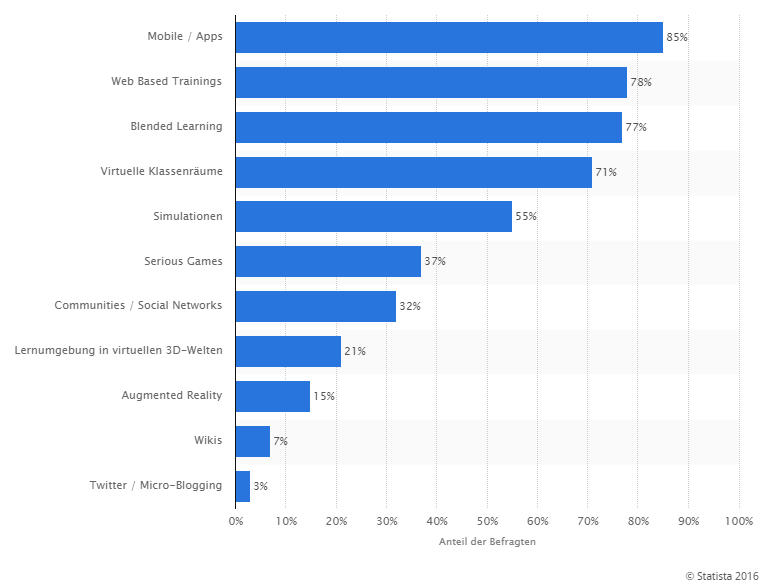
The significant role that M-Learning will play in the future is also shown by an expert study by the MMB-Institute on the question: "Which applications will be commercially very successful in eLearning over the next three years?". 85% of study participants ranked mobile apps as the number 1 most important e-learning form of the future, 78% web-based trainings, 77% blended learning. You can find the entire survey results here.
Especially for companies, mLearning is a great innovation. However, complex topics are still best conveyed in blended learning. This involves e-learning combined with face-to-face events. The learning content of the face-to-face sessions can be wonderfully prepared for, followed up on, and deepened with the help of an eLearning app.
Advantages of Mobile Learning
"What benefit does my company/do I as a learner have from M-Learning?"
Mobile Learning advantages are numerous:
Maximum flexibility!
- Learning with free time management at any location
- also in places without a connection to the learning content (e.g., train or subway)
- effective time management by learning during "empty times"
- thus achieving faster learning progress
- learning in a personal environment
- independence from power supply with a charged battery
- just-in-time learning through always handy mobile devices
Advantages from a methodical-didactic perspective!
- division of learning material into small learning units according to the learning needs of the human brain
- knowledge retrieval through short tests
- conveying pleasure and motivation by linking with "gamification"
- access to further information sources on the Internet
- support for needs- and problem-oriented learning through immediate information retrieval
- combinability with other e-learning forms such as Web Based Training
- good supplement to blended learning
- ideally suited for preparation and follow-up of face-to-face instruction
- allows knowledge to be refreshed and deepened
- promotes communication and interaction between learners themselves and learners and lecturers through features such as instant messaging systems, audio and video recording, and forums
- enables, for example, flexible group work
Technical advantages!
- precise adaptation of mobile learning applications to mobile devices and their user environment
- quick start or re-entry into the learning app through an easily and intuitively operable user interface
- thereby easy resumption of mobile learning after interruptions
- "inhibition threshold" to use a learning app drops (even for tech-averse people)
- constant and effective further development of learning applications thanks to close cooperation of app developers with "digital natives" (frequent users of the Internet and digital products)
- up-to-date content through constant updating
Situational M-Learning!
- evaluation and recording of environmental information by means of context-sensitive apps
- function of such applications as a "guide" or "barometer"
- use of these learning applications, for example, in the laboratory, for research work, the museum, the maintenance project, or on a business trip
Would you like to use a learning app for training and further education in your company? Then please feel free to contact us.
Table of Contents
Ready for training that works?
Get to know keelearning in a personal demo – no obligation and tailored to your needs.
Share
Lorem ipsum dolor sit amet, consectetur adipiscing elit. Suspendisse varius enim in eros elementum tristique. Duis cursus, mi quis viverra ornare, eros dolor interdum nulla, ut commodo diam libero vitae erat. Aenean faucibus nibh et justo cursus id rutrum lorem imperdiet. Nunc ut sem vitae risus tristique posuere.





The learning platform for businesses looking to make their training simple, mobile, and accessible to all – with no IT overhead.