All blog posts
Published on
24.06.2026
AI in E-Learning: Areas of Application, Tools, and Strategy 2026

Lisa Kubatzki
Senior Content Marketing Manager @ keelearning
description
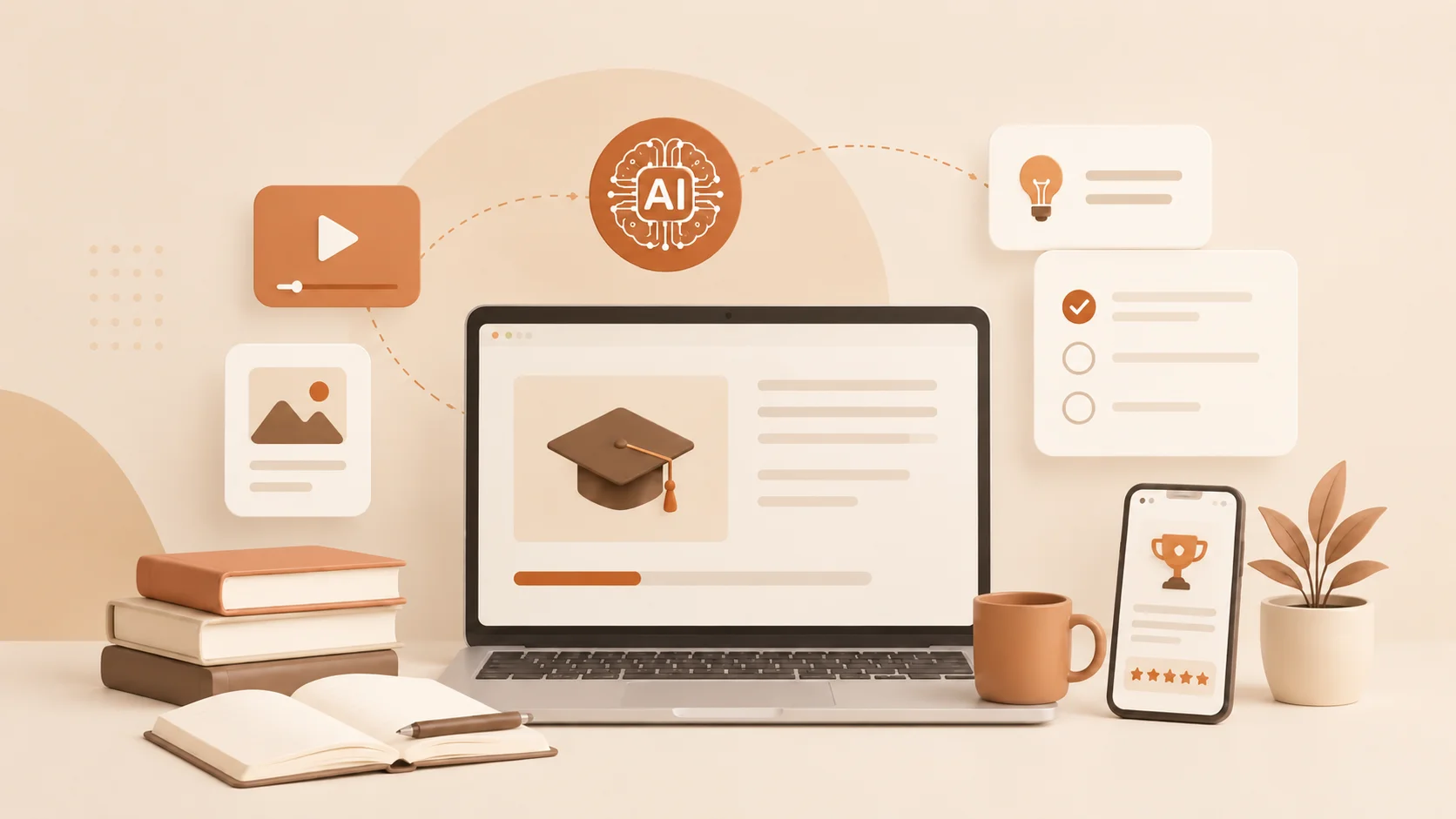
Imagine your e-learning team needs to create a new product training by Friday: including quiz questions, a short script, translation, and a summary for executives. In the past, this would have meant several rounds of coordination, a lot of research, and manual text work. Today, AI can help develop initial learning content from existing knowledge much faster.
AI in e-learning has long since arrived in everyday working life. Many managers are already using it to create content faster, structure knowledge better, or provide training in multiple languages. However, the decisive factor is not whether you use AI. The decisive factor is what you use AI for, what rules apply, and how well the results fit your learning strategy.
The most important answer first: AI is particularly worthwhile when recurring training tasks need to be made more efficient. This includes course drafts, quiz questions, translations, learning paths, summaries, video scripts, knowledge checks, and evaluations. In doing so, AI does not replace didactic responsibility. It helps e-learning teams move from existing knowledge to usable learning content faster.
TL;DR: AI in e-learning at a glance
- AI helps with content creation, translation, personalization, analysis, and knowledge retention.
- AI is particularly valuable for teams that regularly create or update new training content.
- Good results only come from clear learning objectives, human verification, and a clean data basis.
- Risks mainly lie in incorrect content, data protection, bias, and unclear responsibility.
- An AI strategy should start small, prioritize concrete use cases, and measure impact.
- With a platform like keelearning, you combine AI-supported creation, mobile learning formats, and scalable training processes.
What does AI in e-learning mean?
AI in e-learning describes the use of artificial intelligence for the planning, creation, distribution, adaptation, and evaluation of digital learning content. This can start very simply: an AI tool helps to develop a course module from a PDF. But it can also go further: learners receive content tailored to their level of knowledge, chatbots answer questions, or analytics show where content should be improved.
The distinction between assistance and decision-making is important. An AI text generator that creates an initial course draft supports your team. A system that automatically evaluates learning performance or controls access to educational offers can be significantly more sensitive from a regulatory perspective.
For companies in the EU, there is an additional important point: Since February 2, 2025, obligations regarding AI literacy have been in effect as part of the EU AI Act. Companies that use AI systems must ensure that the people working with them possess a sufficient level of AI knowledge.
The EU AI Act classifies certain AI systems in education and vocational training as high-risk, for example, if they influence access, the evaluation of learning outcomes, or examination behavior.
In practice, this means: Use AI first where it relieves the workload, but does not make significant decisions on its own.
How can you use AI in e-learning?
AI is particularly helpful when it solves concrete friction points in everyday training. Therefore, the focus should not be on the use of AI itself, but on the question of which recurring training task is currently costing too much time.
1. Create learning content faster
Much training content is already available: presentations, manuals, process documents, product information, or support answers. AI can derive initial course structures, learning objectives, summaries, checklists, and quiz questions from this.
This saves time but does not replace expert review. Especially with mandatory training, occupational safety, compliance, or product training, a human must check whether the content is correct, complete, and understandable.
2. Automatically translate content
Multilingualism is central to operational teams, international locations, and customer training. AI-powered translations help to provide content in multiple languages faster. This is particularly valuable when training courses are updated regularly.
Nevertheless, the following applies: translation is not the same as localization. Check important content for technical and linguistic accuracy, especially in safety, law, medicine, technology, or sensitive customer topics.
3. Personalize learning paths
Not all learners need the same content. New employees need different information than experienced team members. Customers in an admin role need different training than end-users.
AI can help suggest learning paths based on role, location, language, level of knowledge, or learning behavior. This makes e-learning more relevant and less overwhelming.
Concrete fields of application:
- Onboarding by role
- Product training based on prior knowledge
- Review units for knowledge gaps
- Recommendations for the next learning modules
- Reminders for outstanding mandatory training
4. Make knowledge accessible
A large part of corporate knowledge is hidden in documents, support tickets, chats, or in the minds of experienced team members. AI can help structure this knowledge and make it searchable.
An internal learning assistant can, for example, answer questions such as: "How does the incoming goods process work?" or "What steps apply in the case of a complaint?" It is important that such assistants access verified sources and do not generate free-form answers without a knowledge base.
In addition, the knowledge community from keelearning makes experiential knowledge visible directly within the team. Team members can ask questions, share tips, and publish best practices. This way, knowledge is not just queried, but further developed through exchange. At the same time, the knowledge community connects firstline teams across locations and functions like a social intranet for everyday work.
5. Analyze learning impact
AI can make patterns in learning data visible.
- Which content is frequently aborted?
- With which questions do learners make mistakes?
- Which locations complete training reliably?
- Which topics continue to generate support effort?
This data helps not only to provide e-learning but to continuously improve it. This becomes especially important with many target groups: employee training, customer training, partner training, and product training can only be scaled if the impact remains measurable.
Advantages of AI in e-learning
AI brings four main advantages to e-learning: speed, scalability, accessibility, and better control.
Table of Contents
Ready for training that works?
Get to know keelearning in a personal demo – no obligation and tailored to your needs.
Share
Lorem ipsum dolor sit amet, consectetur adipiscing elit. Suspendisse varius enim in eros elementum tristique. Duis cursus, mi quis viverra ornare, eros dolor interdum nulla, ut commodo diam libero vitae erat. Aenean faucibus nibh et justo cursus id rutrum lorem imperdiet. Nunc ut sem vitae risus tristique posuere.





The learning platform for businesses looking to make their training simple, mobile, and accessible to all – with no IT overhead.