All blog posts
Published on
06.10.2026
AI in knowledge management: use cases, benefits, and the right tools

Lisa Kubatzki
Senior Content Marketing Manager @ keelearning
description

Corporate knowledge is often difficult to find. It is buried in old documents, chat histories, manuals, project folders, emails, or held by experienced employees who have long since become the go-to internal resources.
AI in knowledge management can make information easier to find, structure content, generate summaries, and translate knowledge into multiple languages. However, that alone is not always enough.
A company gains little if employees can find knowledge but cannot understand, apply, or verify it. Especially for operational teams, high turnover, mandatory training, or safety-critical processes, knowledge management requires more than just a smart search.
In this article, you will learn what AI can achieve in knowledge management, where its limits lie, which tools are suitable, and why companies should increasingly distinguish between an AI knowledge base and an AI-powered learning system.
TL;DR: How AI structures, conveys, and preserves knowledge
- AI in knowledge management helps to structure, find, summarize, translate, and provide knowledge more effectively.
- The key difference: Traditional AI knowledge management tools primarily help with finding information. An AI-powered LMS additionally supports learning, verifying, and documenting that knowledge.
- AI is particularly relevant for companies with many operational employees, multilingual teams, high turnover, or the threat of knowledge loss due to retirements.
- Typical use cases include AI-supported media libraries, automatic translation, AI authoring tools, knowledge communities, onboarding, and learning progress analysis.
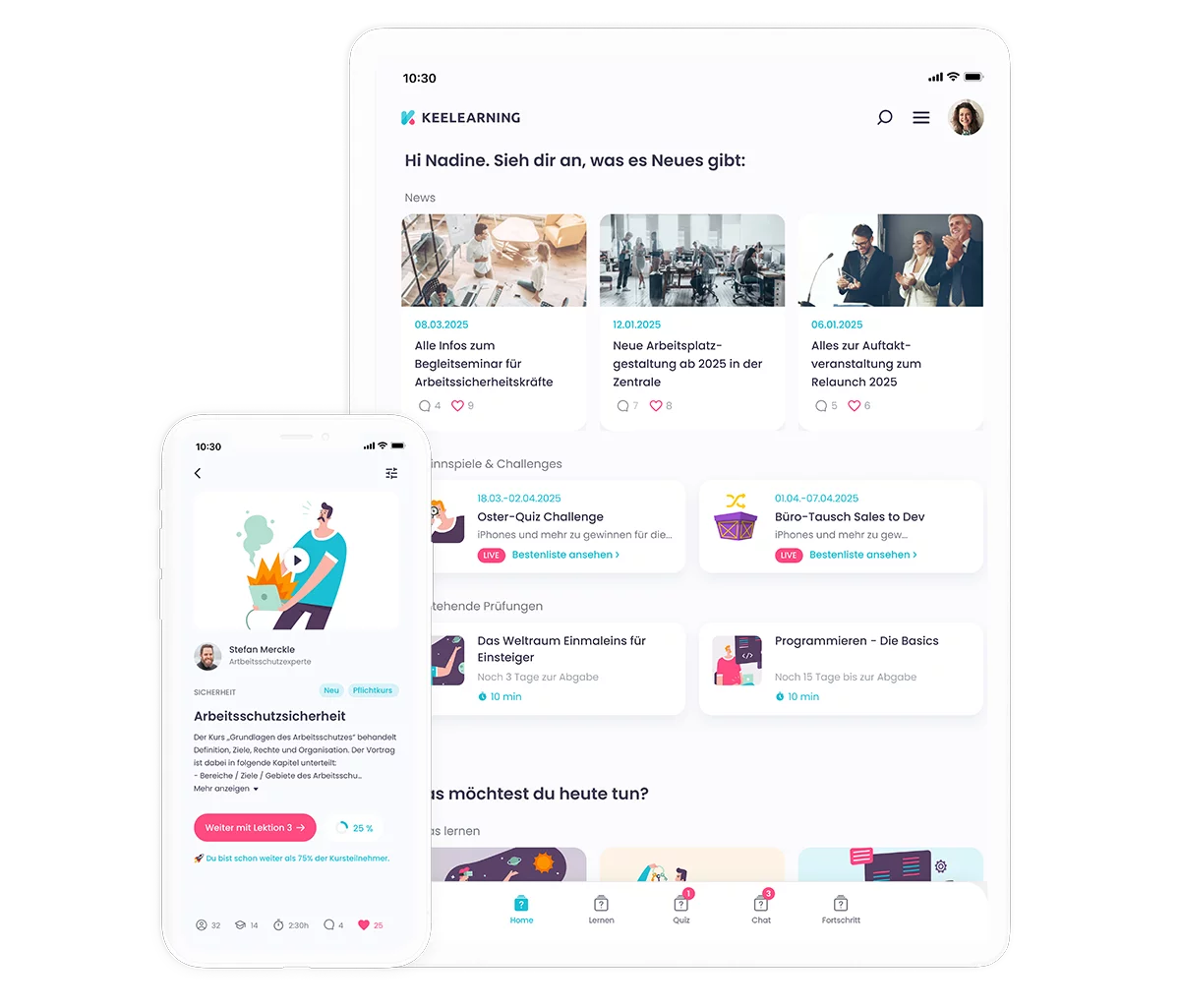
- keelearning is particularly suitable for companies that want to combine knowledge management, training, community, mobile access, multilingualism, and analytics in one platform.
Discover AI-powered knowledge management with keelearning
What does AI in knowledge management mean?
AI in knowledge management describes the use of artificial intelligence to make corporate knowledge more usable. This includes features such as automatic categorization, intelligent search, summarization, translation, recommendations, course creation, and knowledge gap analysis.
It is important to note, however, that AI in knowledge management is not automatically the same as AI-powered document management.
An AI knowledge base primarily answers questions such as:
- Where is the information I am looking for?
- Which documents are relevant to the question?
- What is the content of this long text?
- Which content is thematically similar?
An AI-powered learning system goes further. It also asks:
- Have employees understood the knowledge?
- Can they apply it?
- Which target group needs which content?
- Where are the knowledge gaps?
- Which training sessions must be documented?
This is the crucial difference between a smart library and a smart learning system. A library finds knowledge. A learning system helps to anchor knowledge. You can find more basics on this topic in the article Corporate Knowledge Management.
Why is AI becoming more important in knowledge management now?
Pressure on companies is increasing from several directions. Experienced employees are leaving the company or changing roles. At the same time, processes are becoming more complex, information is becoming outdated faster, and teams are increasingly distributed.
This is particularly evident in production, retail, catering, logistics, and service. Many employees do not have a fixed desk, work in shifts, or speak different primary languages. If knowledge is only stored in document repositories or on the intranet, it often fails to reach these teams reliably.
AI can help here because it prepares content faster and makes it more accessible. Long documents become short summaries. Existing materials become learning modules. A German manual becomes a multilingual course. Test results become indicators of training needs.
Nevertheless, AI remains a tool. It does not replace a culture of knowledge, professional review, or clear responsibility for content. Good results only emerge when technology, processes, and people work together.
7 areas of application for AI in knowledge management
AI can support knowledge management in several areas. The key is that each area of application addresses a specific problem.
1. Automatically structure knowledge
Corporate knowledge is often disorganized: PDFs, presentations, videos, SOPs, manuals, training materials, or internal news. AI can help cluster content, identify topics, and suggest appropriate categories.
This makes it easier for managers to maintain knowledge bases. Instead of sorting every document manually, AI can suggest initial structures. Subject matter experts then verify whether the classification is correct.
2. Converting document content into learning formats
AI can translate existing documents into more accessible formats. A manual, operating instruction, or process description can be turned into an initial course draft.
This is particularly valuable for L&D teams and departments, as the knowledge often already exists but not in a format that is easy for employees to learn from.
An AI-powered authoring tool helps transfer expertise into learning content more quickly. Additionally, the whitepaper Creating E-Learning Courses with AI offers practical insights for course creation.
3. Automatically translating knowledge
Multilingualism is one of the biggest levers for AI in knowledge management. When content is only available in one language, information gaps arise. This particularly affects operational teams, international locations, and safety-related training.
AI can accelerate translations and make content accessible to different language groups faster. It remains important to verify technical terms and safety-critical content.
With automatic translation , learning content and information can be provided more easily for multilingual teams.
4. Identifying knowledge gaps
Knowledge management becomes more effective when managers can see where knowledge is missing. AI can help identify patterns in data: Which questions are frequently searched? Which courses are not being completed? Which quiz questions are often answered incorrectly?
This makes knowledge management more manageable. Companies no longer just react to individual inquiries but identify systematic learning needs.
Example: If many employees fail the same safety test, the problem may not lie with individuals. Perhaps the training is unclear, the topic is too complex, or a refresher is needed.
5. Recommending personalized learning paths
Not all employees need the same knowledge at the same time. AI can help provide content based on role, location, experience, language, or learning progress.
This is particularly relevant for companies with multiple locations or diverse target groups. New employees receive different content than experienced managers. A production team needs different information than sales, service, or HR.
This makes knowledge management more targeted. Less information overload, more relevance.
6. Making implicit knowledge visible
A large portion of corporate knowledge is undocumented. It emerges in conversations, comments, shift handovers, problem-solving, or community posts.
AI can help identify recurring topics, questions, or insights from these types of exchanges. This can then be used to create FAQs, knowledge articles, or learning content.
7. Accelerating onboarding
New employees need orientation quickly. AI can help compile relevant content from existing knowledge bases and develop role-based learning paths from it.
This is especially valuable in cases of high turnover. When knowledge doesn't have to be passed on verbally every single time, managers are relieved of the burden and new employees become confident faster.
An onboarding app helps companies provide knowledge in a structured, mobile, and traceable way.
Traditional knowledge management vs. AI-supported knowledge management
AI does not change knowledge management by making everything run automatically. The difference lies in the fact that knowledge becomes more dynamically usable.
|
Bereich |
Klassisches Wissensmanagement |
KI-gestütztes Wissensmanagement |
|
Suche |
Mitarbeitende suchen manuell in Ordnern, Wikis oder Intranets |
KI schlägt passende Inhalte vor und fasst Informationen zusammen |
|
Struktur |
Kategorien werden manuell gepflegt |
KI erkennt Themen und schlägt Tags oder Cluster vor |
|
Übersetzung |
Inhalte werden einzeln übersetzt |
Übersetzungen können schneller bereitgestellt werden |
|
Aktualisierung |
Verantwortliche prüfen Inhalte manuell |
KI kann veraltete oder häufig genutzte Inhalte sichtbarer machen |
|
Lernen |
Wissen wird bereitgestellt |
Wissen wird in Lernpfade, Kurse und Tests übertragen |
|
Messung |
Nutzung ist oft schwer sichtbar |
Lernfortschritte, Tests und Abschlussquoten zeigen Wissenslücken |
|
Zugang |
häufig desktop- oder dokumentenbasiert |
mobil, zielgruppenspezifisch und mehrsprachig möglich |
Introducing AI knowledge management: 5 steps
Step 1: Identify knowledge and gaps
Start with an inventory. Where does knowledge currently reside? Which content is searched for frequently? Which questions are asked over and over again? Where is there a risk of knowledge being lost?
Interviews, knowledge maps, evaluations, team feedback, and analyses of existing training programs are helpful here.
Step 2: Start with a clear use case
Do not start with the entire company. Choose a specific starting point, for example:
- Onboarding new employees
- Translating existing training materials
- Preparing safety knowledge
- Creating short learning modules from existing documents
- Building a central media library
- Securing institutional knowledge before departures
Step 3: Choose a platform
Clarify whether you primarily want to make information searchable or if you also want to provide training.
If it is just about search, an AI knowledge base may be sufficient. If content needs to be learned, tested, documented, and delivered to mobile devices, an AI-powered LMS is more appropriate.
Step 4: Foster a knowledge culture
AI does not replace the willingness to share. Employees should know how to create posts, ask questions, and pass on their experience.
Managers play an important role in this. They should visibly encourage knowledge sharing and recognize high-quality contributions.
Step 5: Measure impact
Do not just measure whether content exists. Check whether knowledge is being used and understood.
Useful KPIs include:
- Search queries
- most used content
- Course completions
- Test results
- outstanding mandatory training
- Community posts
- Everyday questions
- Onboarding duration
- Content feedback
AI knowledge management tools compared
Not every tool takes the same approach. Some solutions excel at search and documentation. Others combine knowledge management with project work. Still others link knowledge with learning.
Disclaimer: This comparison is current as of July 2027. We strive to keep all information as up-to-date as possible and update it regularly. However, if you would like to familiarize yourself with our competitors' offerings, you should view them via their official websites or contact a representative.
|
Tool-Typ |
Beispiele |
Schwerpunkt |
Geeignet für |
|
KI-Wissensdatenbanken |
Informationen aus bestehenden Quellen auffindbar machen, Antworten generieren, Wissen zentralisieren |
Support, interne Suche, häufige Fragen, Dokumentenwissen |
|
|
KI-Projektmanagement-Tools |
Wissen mit Aufgaben, Projekten, Dokumenten und Teamarbeit verbinden |
Knowledge Worker, Projektteams, interne Zusammenarbeit |
|
|
KI-gestützte Dokumenten- und Intranet-Systeme |
Microsoft-365-nahe Lösungen, Enterprise Search |
Dokumente erschließen, Suche verbessern, Informationen zusammenfassen |
Unternehmen mit starkem Dokumentenfokus |
|
KI-LMS und Lernplattformen |
Wissen in Lerninhalte, Kurse, Tests, Community und Reporting überführen |
HR, L&D, operative Teams, Schulungen, Onboarding, Compliance |
keelearning for AI in knowledge management
keelearning combines knowledge management with learning, communication, and analytics. This makes the platform particularly suitable for companies that want to not only store knowledge but also actively share it.
Particularly relevant features include:
- AI-powered authoring toolto create learning content from existing knowledge
- Media library and news for central documents, videos, updates, and knowledge content
- Automatic translation for multilingual teams
- Knowledge community and collaborative learning for experiential knowledge and exchange
- Mobile access for employees without a fixed desktop workstation
- Tests, quizzes, and analytics to identify knowledge gaps
- Onboarding and training features to distribute knowledge effectively
This turns knowledge management into more than just a storage space. Content is integrated into learning processes, employees can share knowledge, and managers can track how well that knowledge is being absorbed.
Try keelearning for free
Knowledge that sticks: With AI and the right system
Retirements, role changes, and staff turnover cannot be completely prevented. But knowledge loss can. To achieve this, companies must secure knowledge earlier, structure it better, and provide it in a way that employees can actually use.
AI in knowledge management can do a lot: finding information faster, summarizing content, translating knowledge, creating learning materials, and identifying knowledge gaps. However, the greatest benefit arises when AI doesn't just search through documents, but translates knowledge into learning processes.
With keelearning, companies can combine AI, knowledge management, training, community, multilingualism, and reporting into one platform. This creates a knowledge system that not only provides answers but actively supports learning and knowledge transfer.
Book a demo and combine AI with knowledge management
FAQ: AI in knowledge management
What can AI do in knowledge management?
AI can structure knowledge, summarize content, make documents searchable, support translations, create learning materials, and highlight knowledge gaps. AI becomes especially valuable when it doesn't just provide information, but converts knowledge into learning processes.
How does AI-supported knowledge management differ from a traditional knowledge base?
A traditional knowledge base stores information. AI-supported knowledge management can also search, summarize, categorize, translate, and provide information more effectively. An AI-LMS goes even further by connecting knowledge with courses, tests, learning paths, and analytics.
Which AI tools are suitable for corporate knowledge management?
Depending on your goals, AI knowledge bases, enterprise search solutions, AI project management tools, or AI-supported learning platforms are suitable. If you need to train, verify, and document knowledge, a tool like keelearning is particularly useful.
How does AI help secure experiential knowledge before employees leave?
AI can help structure interviews, documents, community posts, or existing materials and convert them into knowledge articles, summaries, or learning modules. It remains important to involve experienced employees early on and have them verify the content.
What is the difference between an AI knowledge base and an AI-LMS?
An AI knowledge base is primarily designed to help you find and summarize information. An AI-powered LMS goes further by helping you deliver and verify knowledge through courses, learning paths, assessments, mobile training, and reporting.
Table of Contents
Ready for training that works?
Get to know keelearning in a personal demo – no obligation and tailored to your needs.
Share





The learning platform for businesses looking to make their training simple, mobile, and accessible to all – with no IT overhead.