All blog posts
Published on
20.05.2026
STOP, START, SCALE: The framework for modern customer training

Lisa Kubatzki
Senior Content Marketing Manager @ keelearning
description

Three phases to immediately get your customer training on the right track.
Most companies do not fail at customer training due to a lack of will. They fail because they do not know what they are doing wrong.
They cling to habits that were once good – and that today actively prevent training from scaling. So, before you start building new courses, it pays to question the existing ones.
There is a simple framework for this: STOP – START – SCALE.
STOP: What you should stop immediately
Some of the most common training formats are not best practices – they are habits that no one has questioned anymore. You should stop three of them now.
1. Live appointments for repetitive content
If you open the same slide deck for three different customers in one week, that content does not belong in an appointment. It belongs in a course.
Live training is valuable – but not for content that repeats week after week. Every hour a trainer spends in a repeatable live appointment is an hour they are not using for real added value: individual consulting, strategic questions, customer retention.
The rule: If you explain the same content more than once in a normal work week, it must be digitized.
2. 90-minute blockbusters
No one watches a 90-minute training video in one go. That is not an opinion – that is a fact about human attention.
Long sessions create a feeling of completeness for the creator, but a feeling of overwhelm for the learner. After twenty minutes, concentration is gone. The course is paused. And often never resumed.
What remains after a long training video? Usually: nothing.
3. Reactive training
Training must not only happen when a customer complains or opens a ticket.
Reactive training is always too late: The damage is already done – the frustration, the lack of success, perhaps even the first thought of cancelling.
Those who train proactively prevent problems before they arise. And that is not only better for the customer – it is significantly cheaper for your support team.
START: What you should start next week
With STOP, space has been created. Now comes START – three concrete steps you can implement immediately.
1. Find the top 3 topics
You don't need an editorial plan or strategy workshops. You need two sources:
- Support tickets: Look at the last 50. Which topics keep coming up? What could have been avoided with good training?
- The Customer Success Team: What questions do they answer every week? What do they explain over and over again?
The intersection of these two sources is your first three course topics.
2. Create an initial course
Now comes the part that many shy away from – and which is actually easier than it sounds: Creating an online course.
You don't have to start from scratch. Break down an existing live training into 10-minute blocks. Or record your top topic anew – a smartphone is enough. Use course templates or AI tools that guide you through the structure.
The most important rule here: One module, one learning objective. What can the customer actually do after this module that they couldn't do before? If you can't answer that in one sentence, the module is still too big.
3. Test internally before you go live
Before the course goes to customers, test it with new employees. You get honest feedback without external risk – and your onboarding becomes more structured in the process.
Customers are polite. Colleagues are not. Use that.
After that: five existing customers as a second test group. Only then roll it out more broadly.
SCALE: What comes later – not now
When the foundation is in place, there are three levers with which you significantly strengthen the impact of your academy.
1. Split content by roles
A standard course is eventually no longer enough. Admins, key users, and end users have fundamentally different needs.
If you notice that a single course is trying to pick everyone up, it's time for role-based learning paths. Each group gets exactly what is relevant for them – nothing more and nothing less.
2. Incorporate game mechanics
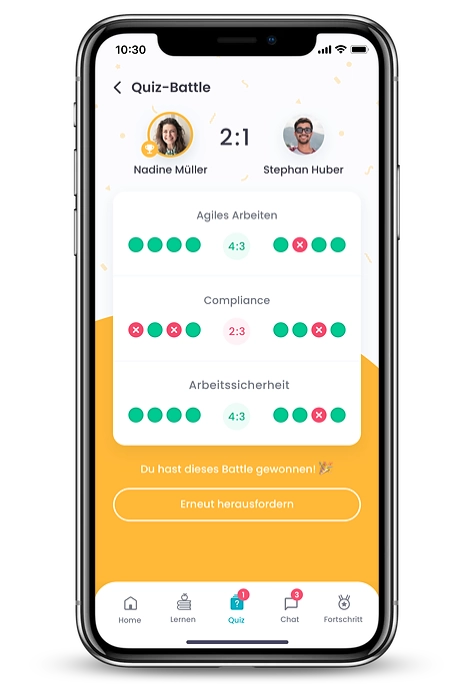
If customers start courses but don't finish them, that's a signal. Not necessarily of bad content – often the incentive to keep going is simply missing.
Quiz battles, points, badges, progress bars: That sounds like kindergarten, but it works. Learning that is fun stays in the memory. And what stays in the memory gets applied.
3. Open a knowledge community

Courses only ever cover a part of the actual knowledge need. What happens on Monday morning when something doesn't work as expected – and there is no course for it?
A knowledge community closes this gap: Customers ask questions in natural language, AI answers from your course content, and other customers add from their own experience. The knowledge that otherwise seeps away in Slack chats becomes permanently usable.
The most important thing at the end
STOP, START, SCALE is not a checklist you work through once. It is a mindset.
Start with STOP. Create space. Then take a first concrete step with START. Scaling comes on its own once the foundation is in place.
And don't forget: Every hour you invest now in a good training structure saves you hundreds of hours of repetition later.
Do you want to see the framework in practice? Take a look at our webinar – including practical experience from Marcus Monecke, who took exactly this path at dataflor AG. Or book a demo directly with keelearning.
Table of Contents
Ready for training that works?
Get to know keelearning in a personal demo – no obligation and tailored to your needs.
Share
Lorem ipsum dolor sit amet, consectetur adipiscing elit. Suspendisse varius enim in eros elementum tristique. Duis cursus, mi quis viverra ornare, eros dolor interdum nulla, ut commodo diam libero vitae erat. Aenean faucibus nibh et justo cursus id rutrum lorem imperdiet. Nunc ut sem vitae risus tristique posuere.





The learning platform for businesses looking to make their training simple, mobile, and accessible to all – with no IT overhead.