All blog posts
Published on
Document training records for audit compliance

Lisa Kubatzki
Senior Content Marketing Manager @ keelearning
description

Audit-proof: How to properly document training records for operational audits
An audit rarely gives much advance notice—and when a trade association, a client auditor, or a certification body asks for training records, it doesn't matter if the training took place; what matters is whether you can prove it in a matter of minutes. Many companies with operational or frontline teams still manage these records using Excel spreadsheets, sign-in sheets, or paper folders—only to realize at that exact moment that it is no longer sufficient.
This article explains what "audit-proof" actually means in the context of training records, which audits and certifications require such documentation, what a legally compliant record must contain, and how to prepare your company for the next audit step by step.
Disclaimer: This article is for general information purposes only and does not constitute legal advice. The legal foundations, deadlines, and assessments mentioned reflect the status as of September 2026 and may change or be subject to different interpretations in individual cases. For a legally binding assessment of your specific situation, we recommend consulting a lawyer or the relevant authority.
{{key-takeaways}}
What does "audit-proof" actually mean for training records?
There is no legal definition of "audit-proof"—the term has become established in practice and describes three characteristics that a record should fulfill:
- Completeness: All relevant information—who was trained, when, and on what topic—is present, not just a portion of it.
- Retrievability: The record can be quickly identified and presented at the time of the audit, rather than having to be searched for.
- Integrity: The record cannot be altered retroactively without being noticed—in digital systems, for example, this is ensured by a date, a timestamp, and an access history.
For occupational health and safety training, Section 4 of DGUV Regulation 1 does not mandate a specific format or necessarily a signature. In practice, however, the burden of proof that training took place lies with the employer—therefore, documenting in an "audit-proof" manner primarily means being able to meet this burden of proof at any time.
Which audits and inspections require training records?
Depending on the industry and company size, various inspections may apply – the specific requirements for training records vary accordingly.
Employer's Liability Insurance Association (BG) audit
Under Section 17 of the German Social Code (SGB VII), professional associations (Berufsgenossenschaften) have a statutory mandate to monitor occupational safety. According to Section 19 (2) No. 3 SGB VII, their inspectors are authorized to "examine the entrepreneur's business and operational documents to the extent necessary for the performance of their supervisory duties." In practice, this regularly includes records of annual safety briefings, specialized training (e.g., for industrial trucks or aerial work platforms), first-aider and fire safety assistant certificates, and hazardous substance training.
SCC certification
SCC (Safety Certificate Contractors) is an occupational health and safety management system primarily relevant for contractors and subcontractors in industry and technical services. It requires recognized training and testing in safety, health, and environment (SHE) for operational employees and managers – without current proof, SCC certification or its maintenance is not possible.
ISO audits (e.g., ISO 9001, ISO 45001)
ISO 9001 requires in Chapter 7.2 "Competence" that persons whose work affects quality performance must have appropriate education, training, or experience – and that documented information must be retained as evidence of this competence, explicitly including personnel working under the organization's supervision, such as temporary staff. In a comparable chapter, ISO 45001 additionally often requires an evaluation of the effectiveness of training measures, which in practice is usually mapped via a competence matrix showing target and actual status.
Customer and store audits
As part of their own due diligence, many clients require proof from contractors and suppliers – such as a valid SCC certificate or branch-specific training records for store audits by retail chains. There are no uniform, cross-industry requirements for this; the specific requirements are generally defined contractually by the respective client.
What must a legally compliant training record contain?
Although there is no uniform formal requirement, a minimum standard has been established in practice, which auditors also use as a guide:
- Name of the person trained
- Date of the training or briefing
- Topic or content related to the respective activity
- Name of the trainer or responsible body
- Confirmation of participation – ideally including a knowledge check rather than just a signature
How long must training records be kept?
There is no uniform statutory retention period for training and briefing records. The DGUV Information 211-005 recommends a minimum retention period of two years as a non-binding guideline. In legal practice, a longer period of around three years is sometimes recommended to be on the safe side. SCC and ISO certification systems generally align with their respective certification or recertification cycles, meaning that records should be kept at least until the next audit.
For companies with multiple locations or high staff turnover, it is advisable to establish a uniform, generously defined internal retention period—regardless of the shortest recommendation—and to apply it consistently across all locations.
Why Excel lists and paper folders often fail in practice
Three weaknesses appear time and again in practice:
- Findability: If you have hundreds of employees and need to find out whose refresher training is due this quarter, you may end up having to check every single row manually.
- Data loss: Paper gets lost, Excel files are accidentally overwritten, or they are only stored locally on a single computer.
- Tamper-proofing: A handwritten list cannot prove that an entry has remained unchanged since it was made—a dated, access-protected digital entry with a log, however, can.
In practice, this often only becomes apparent during an inspection: when an auditor specifically asks for proof regarding a certain person and a specific topic, the result is often a frantic search through multiple folders, email inboxes, or different versions of files from various branches instead of a quick answer. Regardless of the actual training status, this delay rarely inspires confidence in auditors—even if everything is eventually found.
How to manage training records digitally and automatically
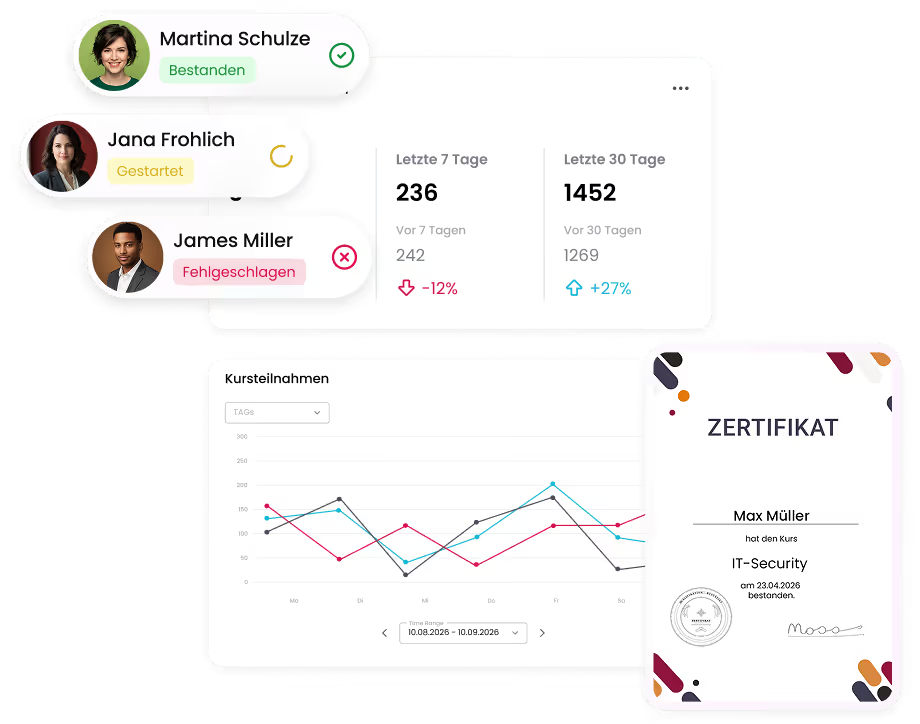
A learning management system like keelearning was developed specifically for this problem: assignment, completion, reminders, and documentation all come together in one place instead of being scattered across individual Excel files or folders.
- Automated certificates of completion: Once a course is completed, a certificate is automatically generated and saved in the user's personal training history.
- Deadline monitoring via escalation management: Through escalation management, keelearning automatically reminds employees of upcoming refresher training. If a deadline is missed, the system automatically notifies supervisors or HR based on defined escalation levels—with every step documented for future audits.
- Centralized compliance overview: The admin dashboard provides a real-time view of who has completed which training and who is behind schedule—across all locations and exportable in seconds, eliminating the need to manually compile Excel lists.
- Verified course templates: The course library and templates include ready-to-use courses on common mandatory topics, so you don't have to create every piece of content from scratch.
{{inline-cta}}
In 5 steps: How to prepare your company for the next audit
1.Conduct an inventory: Which mandatory training courses are relevant for which roles and locations—and where are the corresponding records currently stored?
2.Identify gaps: Where are records missing, and where have deadlines already passed? A central overview makes this visible in minutes instead of days.
3.Centralize records: Bundle existing records and future training in one system instead of continuing to manage them locally at each site.
4.Automate deadline monitoring: Set up recurring training with automatic reminders and escalation instead of relying on manual calendar alerts.
5.Have reports ready before the audit: An exportable compliance report can be generated in seconds when needed, rather than having to be pulled together at the last minute.
Audit readiness checklist: Are you prepared for your next audit?
Before your next operational audit, customer audit, or certification, it is worth performing a quick self-check. You should be able to answer "yes" to the following points:
- It is clearly documented for every role and location which training and instructions are required.
- For every required training session, there is a record including the name, date, topic, and confirmation.
- All records are kept in one central location instead of being scattered across individual sites, inboxes, or folders.
- Deadlines for refresher training are monitored automatically instead of being tracked manually in a calendar.
- A compliance report can be exported within a few minutes without requiring the involvement of multiple people.
- New employees – including temporary staff and contractors – are automatically added to the relevant training plans.
To our interactive training check
Industry-specific requirements at a glance
The fundamental principles in this article apply across all industries, but in practice, the specific regulations differ significantly from one sector to another. In the catering industry, for example, there are additional documentation requirements such as HACCP and the initial or follow-up instruction according to § 43 IfSG. In retail chains, the focus is on youth employment protection and store audits, while in the construction industry, SCC certification often plays a central role.
- Mandatory training and documentation in retail
- Audit-proof hygiene training for the catering industry
- Reliable training documentation in the construction industry
FAQ: Training records for company audits
What happens if records are missing during a professional association (BG) audit?
The inspector can impose requirements and demand improvements. Depending on the severity and whether it is a repeated violation, this can lead to fine proceedings – the professional association has the right to inspect company documents for this purpose under § 19 SGB VII.
Is a signed attendance list sufficient as proof?
In principle, yes, provided that the name, date, topic, and attendance are clearly identifiable. In practice, however, such a list often fails due to the difficulty of locating it quickly during an audit and the lack of a central overview of deadlines.
How long do we need to keep training records?
There is no uniform statutory period. DGUV Information 211-005 provides a non-binding recommendation of at least two years; SCC and ISO systems are usually based on the respective certification cycle. Many companies set a more generous internal period to be on the safe side.
Is Excel sufficient for managing training records if we have few employees?
For very small teams, a well-maintained list can work in day-to-day operations. However, as soon as multiple locations, high staff turnover, or different training deadlines are involved, manual solutions quickly reach their limits – at that point, a centralized, automated solution becomes worthwhile.
What is the difference between a customer audit and an official inspection?
A customer audit is based on contractual agreements with the respective client and has no sovereign authority. An official inspection – for example, by the occupational health and safety authority – can, however, issue legally binding orders and impose fines.
Do we need special software for SCC or ISO certifications?
No specific software is mandatory. However, an LMS with automatic deadline monitoring, certificates, and exportable reporting makes it significantly easier to provide the documented information on competence required by SCC and ISO at any time, rather than having to compile it manually before every audit.
From audit stress to on-demand compliance
Whether it’s a statutory accident insurance audit, SCC certification, ISO audit, or a customer audit: in the end, what matters in every one of these situations is the same – you must be able to prove that training took place, and you need to do it quickly and completely. Anyone still managing records in decentralized Excel lists or paper folders is relying on luck and discipline rather than a system.
With a central platform like keelearning, searching for records becomes a single glance at your dashboard – automated certificates, deadline monitoring, and reporting make your company audit-ready, so you don't have to scramble before every inspection. Get a firsthand look at what this can look like for your teams in a no-obligation demo.
Key Takeaways
- "Audit-proof" means that a record is complete in content, quickly retrievable in the event of an audit, and cannot be altered subsequently without detection.
- BG operational audits (§ 17, § 19 SGB VII), SCC certifications, ISO audits (including ISO 9001, ISO 45001), as well as customer and store audits typically require proof of completed training and instruction.
- Reliable documentation includes the name, date, topic, instructor, and confirmation of participation.
- There is no uniform statutory retention period – DGUV Information 211-005 provides a non-binding recommendation of at least two years, while SCC and ISO systems generally align with their respective certification cycles.
- In practice, Excel lists and paper folders often fail due to issues with retrievability, data loss, and a lack of protection against tampering.
- An LMS like keelearning consolidates automated certificates, deadline monitoring, and centralized reporting in one place – making records retrievable in seconds rather than hours.
Table of Contents
Ready for training that works?
Get to know keelearning in a personal demo – no obligation and tailored to your needs.
Share
Lorem ipsum dolor sit amet, consectetur adipiscing elit. Suspendisse varius enim in eros elementum tristique. Duis cursus, mi quis viverra ornare, eros dolor interdum nulla, ut commodo diam libero vitae erat. Aenean faucibus nibh et justo cursus id rutrum lorem imperdiet. Nunc ut sem vitae risus tristique posuere.



The learning platform for businesses looking to make their training simple, mobile, and accessible to all – with no IT overhead.