All blog posts
Published on
16.09.2026
Training Records for Hospitality Businesses

Lisa Kubatzki
Senior Content Marketing Manager @ keelearning
description

Audit-proof hygiene training for the catering industry: Manage HACCP and IfSG certifications digitally
Disclaimer: This article is for general information purposes only and does not constitute legal advice. The legal foundations, deadlines, and assessments mentioned reflect the status as of September 2026 and are subject to change or may be assessed differently in individual cases. For a legally binding assessment of your specific situation, we recommend consulting a lawyer or the relevant authority.
A common misconception in the catering industry is that the initial briefing at the health department is valid forever and that one hygiene training session per year covers everything else. Neither is correct—and it is precisely this confusion that regularly leads to complaints during food safety inspections or IFS/BRC audits.
This article explains which hygiene and HACCP training courses are legally required in the catering industry, how initial briefings, annual hygiene training, and follow-up briefings differ, what a valid certificate must contain, and how you can organize this digitally and reliably for temporary staff, seasonal workers, and international teams.
{{key-takeaways}}
Which hygiene and HACCP training courses are legally required in the catering industry?
In the catering industry, two different legal frameworks, which are often confused, essentially overlap: the Food Hygiene Ordinance (LMHV) and the Infection Protection Act (IfSG).
Section 4 LMHV: Hygiene training for handling perishable food
Section 4 Food Hygiene Ordinance requires businesses to provide staff without relevant professional training who produce, handle, or sell perishable food with the necessary knowledge of food hygiene based on training. Persons with appropriate professional qualifications are exempt. The law itself does not specify a fixed repetition cycle—an annual refresher has become the industry standard in practice, but it is not a literal requirement of the LMHV.
Note: You can find LMIV training integrated into our LMS.
Section 43 IfSG: Initial briefing and follow-up briefing – the most important difference
Regarding the Infection Protection Act, it is worth taking a closer look, as two different obligations are often confused here:
The follow-up briefing does not replace the initial briefing—both certificates must be kept on-site. Important for operational practice: The follow-up briefing is due every two years, not annually. The annual refresher that many businesses conduct in addition is usually the general hygiene training according to Section 4 LMHV—a separate obligation that is not identical to the IfSG follow-up briefing.
HACCP: Principles instead of an independent training obligation
HACCP (Hazard Analysis and Critical Control Points) is a concept for systematic risk analysis at critical points in food processing. EU Regulation 852/2004 requires food business operators—with the exception of primary production—to apply procedures based on HACCP principles; in Germany, this is implemented via the Food Hygiene Ordinance (LMHV). There is no independent, specifically named "HACCP training requirement" clearly distinguished from general hygiene training under § 4 LMHV in German law; in practice, the communication of HACCP principles is usually part of operational hygiene training.
What is checked during an inspection or an IFS/BRC audit?
During inspections by food safety authorities or the veterinary office, evidence of initial and follow-up briefings as well as internal self-monitoring systems are specifically checked. For certified standards such as IFS Food, "personnel training" is one of the central audit points—the exact detailed requirements regarding frequency and form of evidence are defined by the respective standard and, in case of doubt, should be checked directly with the certifier or in the current standard documentation.
What must a valid training record contain—and how long must it be kept?
Reliable documentation—whether for initial briefings, follow-up briefings, or annual hygiene training—should at least contain:
- Name of the person trained or briefed
- Date of the training or briefing
- Topic or content of the training
- Confirmation of participation, ideally with a signature or digital confirmation
For the initial briefing, there is an additional formal requirement that the certificate from the health department must not be older than three months at the start of employment. There is no uniform statutory retention period for the records themselves; in practice, keeping them for at least two years is often recommended—however, this is a practical recommendation and not an explicit legal deadline. When in doubt, it is better to keep records longer, especially if your business regularly undergoes IFS/BRC audits.
Note: How to securely document training records, you can find out on our blog!
Common reasons for complaints regarding missing or incomplete records
- Missing or expired initial briefing certificate for new staff
- Undocumented or overdue follow-up briefing (every 2 years)
- No or incomplete records for annual hygiene training according to § 4 LMHV
- Records that exist but cannot be found at the time of inspection
The consequences range from requirements and follow-up inspections to fines for repeat offenses—under § 73 of the Infection Protection Act (IfSG), fines of up to 25,000 euros can be imposed on employees, and under the Food and Feed Code (LFGB), fines of up to 100,000 euros can be imposed on businesses for hygiene violations. If the initial briefing is completely missing, the person concerned is also prohibited from working with open, highly perishable food—a work ban that quickly becomes a real problem in day-to-day operations.
Organizing hygiene training for temporary staff, seasonal workers, and international teams
Marginal or short-term employment does not exempt staff from mandatory training – temporary workers, part-time employees, and seasonal staff also require initial instruction and regular hygiene training as soon as they come into contact with perishable food. In chain restaurants, with their seasonal peaks and international teams, this is an organizational challenge: new staff must be trained quickly and in a verifiable manner, often in different languages.
Language barriers are a practical and widely recognized problem in the industry – training that is not understood in terms of content fails its purpose, even if a certificate has been formally signed. Multilingual digital training is a common practical solution here, even if there is no specific legal language requirement for it.
How to manage hygiene training records digitally and audit-proof
An LMS like keelearning bundles assignment, completion, and documentation in one place – a noticeable difference compared to paper folders or Excel lists, especially given the high turnover in the catering industry:
- Automatic certificates: After completing a hygiene training course, a certificate of participation is automatically generated and stored in the personal qualification history.
- Deadline monitoring for annual refresher training: Using escalation management, keelearning automatically reminds employees before a hygiene training session is due. If there is no response, supervisors are also automatically notified according to the defined escalation level – every step is documented.
- Multilingual courses for international and changing teams: Via the multilingual learning platform, hygiene training courses are automatically available in over 20 languages – including translated certificates, so that language barriers for temporary and seasonal staff are no longer an obstacle to verifiable, understood training.
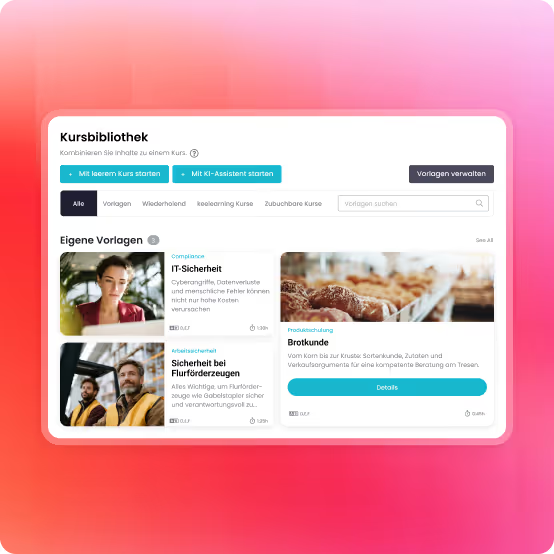
- Ready-made course templates: The course library and templates already contain templates for hygiene and HACCP basics, so that each business does not have to develop its own training content from scratch.
- Centralized Compliance Overview: The admin dashboard gives you an at-a-glance view of who has completed which training and where a follow-up session is due – all exportable for inspections and audits.
{{inline-cta}}
We explore how digital learning can be applied in practice specifically for catering businesses in more detail in our article E-Learning in the Gastronomy Industry as well as in Staff Training in the Catering Industry. Our article on Employee Apps for the Gastronomy Industry also provides an overview of mobile use in the workplace.
FAQ: HACCP and IfSG Compliance in the Catering Industry
Does the training according to § 43 IfSG have to be repeated annually?
No. The follow-up training required by the employer under § 43 Para. 4 IfSG is due every two years, not annually. An additional annual refresher is usually the hygiene training according to § 4 LMHV – an independent, separate obligation.
Is the initial training by the health department sufficient for the entire duration of employment?
The initial training is a one-time requirement, but it must be supplemented by the employer's follow-up training every two years. Both records – initial and follow-up training – must be kept on-site.
Are temporary staff and seasonal workers exempt from the mandatory hygiene training?
No. The type of employment does not change the training obligation as soon as work involves perishable food – even part-time and seasonal workers require valid proof.
What happens if a person works without valid initial training?
Without valid initial training, the person concerned is prohibited from working with open, perishable food – there is a statutory work ban. In addition, fines may be imposed during inspections.
How long should we keep training records?
There is no strictly defined statutory period. In practice, a minimum retention period of two years is often recommended; for regular IFS/BRC audits, a more generous internal timeframe is advisable.
Hygiene records that are ready at a moment's notice
Keeping initial training, follow-up training, and annual hygiene briefings clearly separated is the first step toward audit-proof documentation in the catering industry. The second step is organizing these records so that they can be produced in just a few minutes during an unannounced inspection by food safety authorities or an IFS/BRC audit—which is by no means a given, especially with high staff turnover among temporary and seasonal workers.
With keelearning, you can manage hygiene training, certificates, and deadlines centrally and in multiple languages, rather than manually tracking down records across branches and seasonal staff. Get a feel for how this could work for your business in a no-obligation demo.
Key Takeaways
- The initial instruction according to § 43 para. 1 IfSG is provided once by the public health department or an authorized physician and must not be older than three months at the start of employment.
- Follow-up instruction according to § 43 para. 4 IfSG is the responsibility of the employer and must be repeated every two years thereafter – not annually, as is often assumed.
- In addition, § 4 LMHV requires hygiene training for staff without relevant training in handling highly perishable foods; the law itself does not specify a fixed interval for this, but an annual refresher has become established industry practice.
- HACCP principles are mandatory under EU Regulation 852/2004; however, there is no clear distinction in German law between a standalone "HACCP training requirement" and general hygiene training under § 4 LMHV.
- Missing or expired proof of instruction can lead to official requirements, fines in the event of repeat offenses, and, in the case of the initial instruction, even a prohibition from working.
- Even part-time employees, seasonal workers, and temporary staff are not exempt from the training requirement – an LMS with automated certificates, deadline monitoring, and multilingual courses makes organization easier, especially when staff turnover is high.
Table of Contents
Ready for training that works?
Get to know keelearning in a personal demo – no obligation and tailored to your needs.
Share
Lorem ipsum dolor sit amet, consectetur adipiscing elit. Suspendisse varius enim in eros elementum tristique. Duis cursus, mi quis viverra ornare, eros dolor interdum nulla, ut commodo diam libero vitae erat. Aenean faucibus nibh et justo cursus id rutrum lorem imperdiet. Nunc ut sem vitae risus tristique posuere.



The learning platform for businesses looking to make their training simple, mobile, and accessible to all – with no IT overhead.