All blog posts
Published on
16.09.2026
Mandatory Training and Compliance in Retail

Lisa Kubatzki
Senior Content Marketing Manager @ keelearning
description

Mandatory training in retail: Proof of compliance for inspections and audits
A store manager may have conducted every training session correctly, but if no one can produce the proof during a store audit or an inspection by health and safety authorities, it effectively counts for nothing. This is a common problem in retail chains: dozens or hundreds of locations, high staff turnover due to temporary workers and seasonal staff, and documentation scattered across loose papers, folders, or local Excel lists at each branch.
This article outlines which mandatory training sessions are legally required in the German retail sector, what applies to young employees and temporary staff, how store audits differ from official inspections, and how to document proof centrally rather than locally at each branch.
{{key-takeaways}}
Which mandatory training sessions are legally required in retail?
The basis for most mandatory training in retail is Section 12 of the Occupational Health and Safety Act (ArbSchG) in conjunction with Section 4 of DGUV Regulation 1: Employers must provide employees with sufficient and appropriate instruction on safety and health protection at work, at least once a year and additionally as needed—for example, when tasks, equipment, or work processes change, or following an accident.
For retail chain operations, the following training sessions are particularly relevant:
Depending on the product range, further obligations may apply: If a store has a fresh food or bakery counter, the mandatory food hygiene training under Section 4 of the Food Hygiene Ordinance (LMHV) applies, as well as initial and follow-up briefings under Section 43 of the Infection Protection Act (IfSG)—more on this in our article on audit-proof hygiene training.
What is not a legal requirement—but still makes sense
Topics such as robbery prevention, handling shoplifting, or de-escalation in customer interactions are often referred to as "mandatory training" in practice, but in a strict sense, they are not independent legal training requirements. They arise indirectly from the employer's duty of care under Section 5 of the Occupational Health and Safety Act (ArbSchG) and the company's risk assessment. For branches with increased risk—such as those in high-traffic locations or those handling cash—it is still advisable to provide regular training on these topics, even if there is no fixed legal deadline.
Young employees, temporary staff, and seasonal workers: What applies under the Youth Employment Protection Act (JArbSchG)
The retail sector traditionally employs many people under the age of 18—as apprentices, seasonal workers, or temporary staff during school holidays. A stricter rule applies to them than to adult employees: According to Section 29 (2) of the Youth Employment Protection Act (JArbSchG), training must be repeated "at appropriate intervals, but at least every six months." An annual training session, as is the case for adult employees, is therefore not sufficient here.
Violating this duty is not merely a formal error: Under Section 59 (1) No. 3 of the JArbSchG, it is an administrative offense if young people are not instructed about hazards, or are instructed incorrectly or not in a timely manner. The fine can be up to 5,000 euros under Section 59 (3) of the JArbSchG. Especially for retail chains with many young temporary workers at different locations, a central overview of who was trained and when is highly valuable—maintaining this manually is hardly reliable given high turnover rates.
Store audits and official inspections: What is the difference?
When people in retail talk about "audits," they often mean two very different types of inspections:
- Store audits are internal quality controls conducted by a retail chain or franchise headquarters, sometimes on behalf of brand partners. They use checklists to verify, among other things, brand standards, product presentation, hygiene, and often whether mandatory training is documented. They are predictable, recurring, and carry no sovereign authority—there is no risk of fines, though there may be internal consequences, including requirements imposed by headquarters.
- Regulatory inspections by occupational health and safety authorities or trade inspectorates are based on the inspection and enforcement powers granted under §§ 21–22 of the German Occupational Health and Safety Act (ArbSchG). These inspections can be unannounced, may include requests to review training records, and can result in official orders or the initiation of fine proceedings in the event of violations. Additionally, professional associations (Berufsgenossenschaften) also conduct operational audits as part of their mandate for accident prevention.
The same practical principle applies to both types of audits: records must be quickly accessible—ideally in a centralized location across all branches, rather than having to be searched for at the specific branch being inspected.
What makes a training record legally compliant?
§ 4 of DGUV Regulation 1 does not mandate a specific format for documentation, nor does it strictly require a signature. However, in practice, the employer bears the burden of proof that training has taken place. Therefore, to ensure a record holds up in a legal dispute, it should at least contain the following information:
- Name of the person trained
- Date of the training
- Topic or content related to the specific workplace
- Name of the person conducting the training
- Confirmation of participation—ideally including a comprehension check rather than just a signature
There is no uniform statutory retention period. DGUV Information 211-005 provides a non-binding recommendation to retain records for at least two years; depending on operational practices and risk levels, some companies choose to keep them longer. For companies with multiple branches, it is advisable to establish this period as an internal minimum standard across the board, rather than handling it differently from branch to branch.
Typical weaknesses in record-keeping across multiple branches
Chains with many locations often face the same recurring problems:
- Records are kept locally at each branch—if an inspector visits Branch A, a well-maintained folder at Branch B is of no help.
- Excel spreadsheets are maintained differently by various people, leading to inconsistent formats.
- When employees change or branches close, records are lost or not migrated.
- Deadlines for refresher training—especially the mandatory semi-annual training for minors—are not monitored centrally and are simply overlooked.
- Corporate headquarters lacks an up-to-date overview of which branches are behind on which topics.
How to document training records centrally and across all branches
A Learning Management System (LMS) keelearning solves these problems structurally because assignment, completion, and documentation are consolidated in one place instead of being scattered across branches:
1. Centrally assign mandatory training: HR or headquarters can assign courses on occupational safety, fire safety, or youth employment protection to all relevant branches and employees simultaneously, rather than coordinating each branch individually. (Tip: We provide you with an overview of the courses already included in keelearning's LMS)
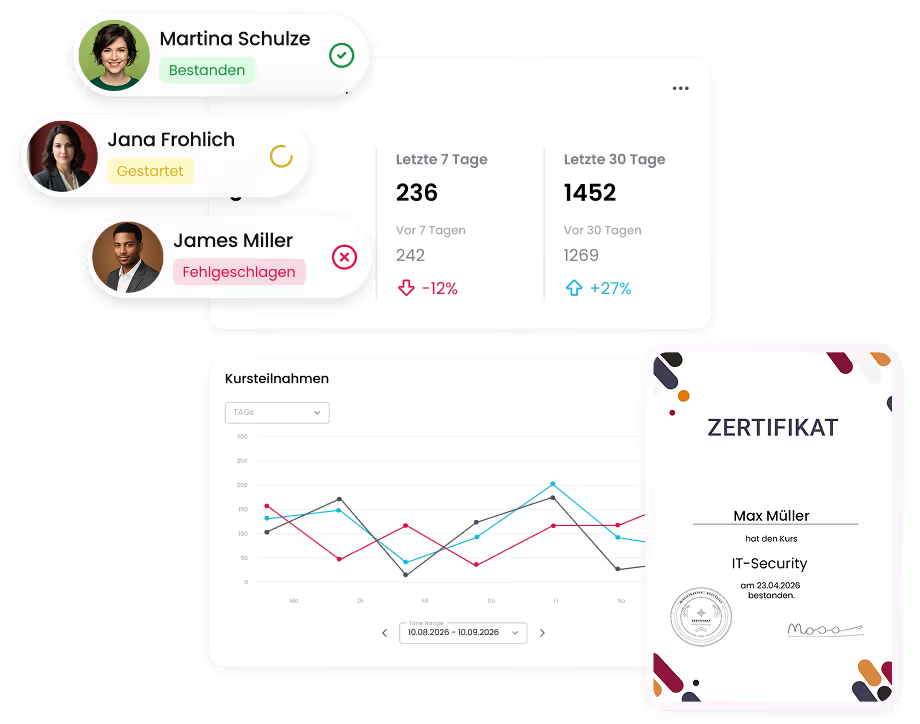
2. Automatic reminders and escalation: Using escalation management, keelearning automatically reminds employees of upcoming refresher training. If a deadline is missed, branch managers or HR are automatically notified based on defined escalation levels, eliminating the need for manual follow-up.
3. Automatic certificates as proof: Upon course completion, a certificate is automatically generated and stored in the personal qualification history—no paper files or signature lists required.
4. Centralized overview instead of branch Excel sheets: The admin dashboard gives you an at-a-glance view of who has completed which course and who is behind schedule—across all branches and locations, and exportable for audits and inspections.
5. Multilingual support for temporary staff and international teams: About Autotranslate courses are automatically available in over 20 languages – helpful for branch teams with high turnover and varying language skills.
Read more about using keelearning specifically for retail branch teams in our article Employee app for retail, and you can find an overview of industry-specific use cases at LMS for retail.
{{inline-cta}}
FAQ: Mandatory training and proof of compliance in retail
How often do I need to train retail employees?
Adult employees must be trained at least once a year and additionally on an ad-hoc basis, for example when taking on new tasks. According to Section 29 (2) of the Youth Employment Protection Act (JArbSchG), young employees, apprentices, and minors in holiday jobs must be trained at least every six months.
Is a signed attendance list sufficient as proof?
A signature list including the date, topic, and names is generally an acceptable form of proof. In practice, however, it often fails in companies with multiple branches due to difficulties in locating the documents during an audit and a lack of a central overview of deadlines – a digital, centralized documentation system is therefore usually the more practical solution.
What happens if proof is missing during an inspection?
That depends on the type of inspection: An internal store audit usually results in requirements from headquarters. In the event of an official inspection, the occupational health and safety authority can issue orders; under Section 59 of the Youth Employment Protection Act (JArbSchG), failure to train young employees can result in a fine of up to 5,000 euros.
Do marginal employees and temporary staff also need to be trained?
Yes. The type of employment—whether a mini-job, temporary help, or summer job—does not change the employer's fundamental obligation to provide training. For minor employees, the semi-annual refresher requirement under the Youth Employment Protection Act (JArbSchG) also applies.
How long should we keep training records?
There is no uniform statutory period. DGUV Information 211-005 provides a non-binding recommendation of at least two years; many companies set a longer internal period to ensure they are covered for future inquiries or audits.
Records that are easy to find, even on the busiest day in the store
Conducting mandatory retail training is only half the job—providing complete documentation in an emergency is the other. Especially with multiple locations, high staff turnover, and the stricter semi-annual requirement for minors, a decentralized, paper-based solution quickly becomes insufficient.
With a central platform like keelearning, you can keep track of assignments, reminders, escalations, and documentation for all locations—no matter how many branches or temporary staff you have. Get a firsthand look at how this can work for your retail network in a non-binding demo.
Key Takeaways
- General occupational safety training is mandatory under Section 12 of the German Occupational Health and Safety Act (ArbSchG) and Section 4 of DGUV Regulation 1 – it must be conducted at least annually and on an ad-hoc basis, such as when introducing new tasks or equipment.
- For young employees, apprentices, and minors in holiday jobs, Section 29 (2) of the Youth Employment Protection Act (JArbSchG) requires training to be repeated at least every six months; failure to comply is subject to fines of up to 5,000 euros under Section 59 JArbSchG.
- Store audits are internal or franchise quality controls without official regulatory authority. In contrast, inspections by occupational health and safety authorities or trade supervisory boards can result in official orders and the initiation of fine proceedings.
- A reliable record of training should include the name, date, topic, the person conducting the training, and confirmation from the participants. While Section 4 of DGUV Regulation 1 does not prescribe a specific legal format, the burden of proof lies with the employer in the event of a dispute.
- Decentralized Excel lists for each branch are the most common weak point during audits: they lack an overview of deadlines, become outdated when staff changes, and offer no automated reminders.
- A centralized LMS like keelearning consolidates assignments, reminders, escalations, and certificate verification for all branches in one place – even with high turnover among temporary staff.
Table of Contents
Ready for training that works?
Get to know keelearning in a personal demo – no obligation and tailored to your needs.
Share
Lorem ipsum dolor sit amet, consectetur adipiscing elit. Suspendisse varius enim in eros elementum tristique. Duis cursus, mi quis viverra ornare, eros dolor interdum nulla, ut commodo diam libero vitae erat. Aenean faucibus nibh et justo cursus id rutrum lorem imperdiet. Nunc ut sem vitae risus tristique posuere.



The learning platform for businesses looking to make their training simple, mobile, and accessible to all – with no IT overhead.