All blog posts
Published on
21.02.2022
E-Learning Occupational Safety: Practical relevance and good understandability

Norma Demuro
E-Learning Expert, CEO @ keelearning
description
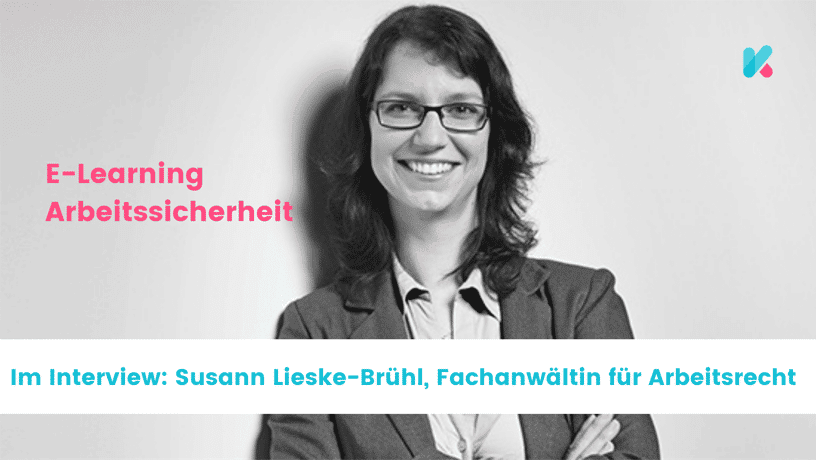
In an interview: Susann Lieske-Brühl, specialized lawyer for labor law
The implementation of occupational safety and health protection is not only mandatory for companies when it comes to preventing accidents in the work environment. The topic also raises many questions for laypeople. Susann Lieske-Brühl sheds light on relevant questions for companies from a legal perspective and explains the advantages of completing the e-learning from keeunit instead of struggling through regulations yourself.
What is the biggest challenge in this area?
The biggest challenge is to keep track of the multitude of occupational safety regulations, which are distributed across various laws and sets of rules, in order to be able to offer employees the best possible occupational safety and, beyond that, to avoid official fines and penalties.
What are the advantages of the occupational safety explanatory video or what do you like about it?
I like its practical relevance and how easy it is to understand.
Why is the topic of occupational safety important for companies?
Section 618 of the German Civil Code (BGB) obliges the party entitled to services and the employer to set up and maintain the rooms, devices, or equipment that they have to provide for the performance of the services, and to regulate the services that are to be performed under their order or direction, in such a way that the obligor is protected against danger to life and health as far as the nature of the service permits.
It is therefore about guaranteeing safety at the workplace, i.e., protection against health hazards at work and through work by means of accident protection, the prevention of occupational diseases, and work-related illnesses.
In addition to the regulation from the German Civil Code (BGB) cited at the beginning, there are also other, specific obligations for the employer in a multitude of other laws (ArbSchG [Occupational Health and Safety Act], ASiG [Occupational Safety Act], etc.) and sets of rules (ArbeitsstättenVO [Workplace Ordinance], DGUV [German Social Accident Insurance], etc.). If the employer ignores one of these obligations and an industrial accident results from this, there is a risk that they will be liable for the damages incurred by the employee. This can be associated with considerable costs.
Do companies have to check learning success or provide proof?
The Occupational Health and Safety Act (ArbSchG) stipulates in Section 12 that the employer must instruct employees on safety and health protection at work during their working hours in a sufficient and appropriate manner. This includes instructions and explanations that are specifically geared to the workplace or the area of responsibility of the employees.
A subsequent check of the learning success by the employer or even just written proof of the instruction is not explicitly prescribed in the ArbSchG. Various special regulations, however (such as the GefahrstoffVO [Hazardous Substances Ordinance]), oblige the employer to record the content and time of the instruction in writing and to have it confirmed by the instructed persons with their signature. The autonomous law of the accident insurance institutions (DGUV) also requires the documentation of the instruction regarding the company, content of the instruction, and the name and signature of those involved. Although the latter does not establish a legal obligation, it can be relevant for liability issues!
In principle, the following must also be considered: The sense and purpose of the instruction is that employees should acquire and practice the necessary knowledge and skills to behave in a way that is safe and healthy at their work. The instruction is therefore more than a mere admonition. The purpose of the provision requires rather that the employer makes use of recognized methods of work pedagogy and work psychology. A comprehension check and its written fixation can therefore be sensible to ensure that the instruction has fulfilled its purpose and the employer thus complies with their legal obligations.
What consequences do companies face if the mandatory training is not offered?
Occupational safety law establishes, on the one hand, public law obligations of the employer. This means that the obligation to comply with the public law occupational safety regulations exists in principle towards the state. Their implementation is monitored administratively, primarily by the trade supervisory offices; their violation can constitute an administrative offense or even a criminal offense.
Besides this, the occupational safety law obligations also exist under private law towards the employee. In many cases, such as in the case of instruction according to Section 12 ArbSchG ("mandatory training"), these are contractual ancillary obligations.
If the employer does not comply with the occupational safety regulations, the employee has a right to refuse performance (Section 273 BGB) until the proper implementation of the required occupational safety measure, such as the necessary instruction. Furthermore, the employee may have a claim for damages (Section 280 BGB) if the employer culpably violates an occupational safety law obligation and thereby the employee themselves or property belonging to them is damaged.
Although the damages are often covered by accident insurance and the liability of the employer is therefore limited (Section 104 SGB VII), it must be noted that according to Section 110 SGB VII, the accident insurance institution can take recourse against the entrepreneur in the event of intent or gross negligence. In the event of a violation of the DGUV, jurisprudence regularly assumes gross negligence, so that it will be difficult for the employer to refute the accusation of gross negligence if they have not carried out, or have not carried out correctly or comprehensively enough, an instruction.
>> E-Learning Occupational Safety from keeunit
Can companies force their employees to complete the mandatory occupational safety training?
Compliance with occupational safety regulations cannot be waived – not even by the employees. This means that the employees, within the scope of their employment contract, have the duty to participate attentively in the instructions.
What consequences do employees face if they do not complete the training?
Disregarding the duty to participate in instructions can have labor law consequences. Since participation in instructions is an ordinary contractual ancillary obligation of the employee, all measures of the employer that they can also apply in other cases of (ancillary) breach of duty are conceivable. These are, on the one hand, disciplinary consequences such as a warning and, in the case of persistent refusal, potentially also termination.
Furthermore, for certain particularly dangerous activities, it is possible that uninstructed employees may not carry out the activity in question, and the employer therefore cannot assign the relevant tasks to the employee. In this case, however, the employer does not have to pay the employee any remuneration, just as in the case of a refusal to work. Under certain circumstances, even claims for damages can come into consideration.
What happens if an accident occurs anyway?
Even if the employee has refused to participate in an instruction, they still benefit from the protection of the statutory accident insurance in the event of an industrial accident, as the benefits under accident insurance law are, in principle, granted regardless of fault. After an industrial accident, the usual procedure is therefore to be followed; the employee must visit the accident insurance consultant (Durchgangsarzt) and the employer must report the accident to the professional association (Berufsgenossenschaft) within three days (if the accident is associated with incapacity for work of more than three days). The employer is then – except in cases of intent – exempt from liability (Section 104 SGB VII).
However, the breach of duty by the employee can be relevant for the liability-law follow-up questions of the accident. If the accident insurance institution takes recourse against the entrepreneur in accordance with Section 110 SGB VII, for example because they have carried out the instruction with gross negligence (violation of DGUV) or incorrectly (or not at all), this claim is limited to the amount of the civil law claim for damages. Any contributory negligence of the employee according to Section 254 BGB has a damage-reducing effect here.
The employee will regularly be accused of considerable contributory negligence for the accident, insofar as the accident would not have happened, or not to the same extent, through participation in the instruction. Contributory negligence is of course also to be taken into account if the employer is directly liable to the employee, for example if the liability privilege in Section 104 SGB VII does not apply.
>> Learning Video Occupational Safety from keeunit
Where do problems frequently occur, or which accidents could be easily avoided?
In principle, problems can occur at any point in the work process and in retrospect, many industrial accidents appear to be avoidable. The sources of risk concern a multitude of possible case scenarios, such as simple tripping hazards on the company premises, the lack of experience of employees regarding work processes, carelessly executed work movements due to routine, the incorrect use of work equipment, or the use of faulty work equipment.
A final list is naturally not possible. Therefore, preventive occupational safety measures are essential, which sharpen the safety awareness of employees generally as well as with regard to specific sources of danger, e.g., instructions within the meaning of Section 12 ArbSchG.
Which accidents happen most frequently statistically?
According to the data from the DGUV, a total of 786,803 reportable industrial accidents occurred in 2018, which resulted in incapacity for work of more than three days or death.
29.7% of the accidents happened from movement (walking, running, etc.); 17.2% resulted from manual or motor-manual work with a tool; 20.1% had the manual handling of objects as a cause (picking up, holding, binding, opening, closing, etc.); 11.4% occurred due to the transport of objects and 5.4% resulted from the operation of a machine. The remaining 16.6% cannot be precisely assigned.
It should be noted that material damage only led to 8.6% of reportable industrial accidents, while 49.0% of the accidents were based on movements of the injured person and 33.3% had the loss of control over tools, machines, and means of transport as a cause.
Subdivided into the various sectors of the economy, the DGUV data provide the following picture: Manufacturing industry/manufacture of goods 28%; construction industry/construction 15.5%; trade; maintenance and repair of motor vehicles 14.2%; transport & warehousing 10.1%; provision of other economic services 9.1%; health & social services 8.1%; hospitality/accommodation & gastronomy 4.2%; arts, entertainment & recreation 1.9; others 8.9%.
The number of fatal industrial accidents was 399 in 2020. More details at https://www.dguv.de/de/zahlen-fakten/au-wu-geschehen/index.jsp
Further information from the year 2020 at:
https://publikationen.dguv.de/widgets/pdf/download/article/4271
With which type of accidents is there uncertainty among employers as to whether it is an industrial accident or not?
The term industrial accident is defined in Section 8 SGB VII. Industrial accidents are therefore accidents of insured persons as a result of an activity that justifies insurance coverage (insured activity). Accidents are defined here as events limited in time, acting from the outside on the body, which lead to a health injury or death. The insured activity must have been causal ("as a result of") for the accident. This excludes such accidents from the scope of protection of the statutory accident insurance whose essential cause does not lie in the insured activity, but which are to be attributed to the uninsured private sphere (e.g., influence of alcohol).
Finally, the accident must in turn be causal for the health damage, which can then become significant if the accident event acts upon an already existing bodily injury.
The covering of the direct path to and from the place of the activity connected with the insured activity is also to be regarded as an insured activity. So-called commuting accidents are therefore also to be regarded as a sub-type of the industrial accident. Detours by the insured driver to entrust own children to foreign care or to form a carpool do not preclude the assumption of a commuting accident.
However, if the driver deviates from the path for private reasons (shopping, visits), they are not under insurance coverage.
The question of whether an accident meets the aforementioned requirements in the specific case and thus counts as an industrial accident always depends on the individual case.
Thank you very much for the interview!
Now discover the occupational safety explanatory video from keeunit
Looking for e-learning?
Are you looking for an occupational safety explanatory video or digital learning training for a completely different area? Whether data protection, quality management, or IT security - we develop your e-learning. You will find standard content with us just as well as custom-made products.
Talk to us - we look forward to your inquiry.
Your keeunit team
Table of Contents
Ready for training that works?
Get to know keelearning in a personal demo – no obligation and tailored to your needs.
Share
Lorem ipsum dolor sit amet, consectetur adipiscing elit. Suspendisse varius enim in eros elementum tristique. Duis cursus, mi quis viverra ornare, eros dolor interdum nulla, ut commodo diam libero vitae erat. Aenean faucibus nibh et justo cursus id rutrum lorem imperdiet. Nunc ut sem vitae risus tristique posuere.




The learning platform for businesses looking to make their training simple, mobile, and accessible to all – with no IT overhead.