All blog posts
Published on
06.10.2026
Collaborative knowledge management: Definition, methods, and tools for companies

Lisa Kubatzki
Senior Content Marketing Manager @ keelearning
description

An employee asks in the team chat how a new process works. Two colleagues respond with practical tips. An experienced specialist adds a short video. A manager marks the solution as a best practice. The next day, other teams find the same answer without having to ask again.
That is exactly what collaborative knowledge management is all about: knowledge is not just collected centrally, but created, shared, discussed, and developed together.
In this article, you will learn what collaborative knowledge management means, how it differs from traditional knowledge management, which methods have proven successful, and which tools support companies in promoting knowledge sharing in everyday work.
TL;DR: Collaborative Knowledge Management in Practice
- Collaborative knowledge management means building, sharing, and continuously improving knowledge together.
- Unlike traditional knowledge management, knowledge is not just created top-down, but also by employees, teams, and communities.
- Participation, trust, simple digital spaces, clear responsibilities, and visible benefits in everyday work are particularly important.
- Suitable methods include Communities of Practice, peer learning, mentoring, after-action reviews, lessons learned, and user-generated content.
- The tool comparison features keelearning, Confluence, Microsoft Teams, Notion and Stack Overflow for Teams introduced. keelearning is particularly well-suited when you want to combine collaborative knowledge management with learning, community, chat, mobile access, and analytics.
Implementing collaborative knowledge management with keelearning
What is collaborative knowledge management?
Collaborative knowledge management describes an approach where knowledge is not managed by a single central authority. Instead, employees actively participate in creating, supplementing, commenting on, verifying, and sharing knowledge.
Traditional knowledge management often works like this: a department creates content, stores it in a wiki or folder, and expects others to find it when needed. Collaborative knowledge management takes a different approach. It asks: How is knowledge created in everyday work? Who knows something that helps others? How do we make this knowledge visible?
At its core, it is based on four principles:
- Participation: Employees actively contribute knowledge.
- Co-creation: Content is created and developed together.
- Decentralization: Knowledge does not just come from HR, L&D, or management levels.
- Exchange: Questions, comments, and feedback are part of the system.
Collaborative knowledge management is therefore closely linked to social learning, peer learning, and community-based learning. You can find a complementary perspective on learning through exchange in the article Peer-to-peer learning in e-learning.
Traditional vs. collaborative knowledge management
The difference is simple: traditional knowledge management stores knowledge. Collaborative knowledge management gets people to make knowledge usable together.
|
Bereich |
Klassisches Wissensmanagement |
Kollaboratives Wissensmanagement |
|
Wissensquelle |
zentrale Fachabteilungen |
Mitarbeitende, Teams, Expert:innen und Communitys |
|
Richtung |
häufig top-down |
top-down und bottom-up |
|
Format |
Dokumente, Handbücher, Wikis |
Beiträge, Kurse, Videos, Kommentare, Fragen, Diskussionen |
|
Rolle der Mitarbeitenden |
konsumieren Wissen |
erstellen, bewerten und teilen Wissen |
|
Aktualisierung |
feste Verantwortliche |
gemeinsame Pflege mit Moderation |
|
Ziel |
Wissen auffindbar machen |
Wissen lebendig halten und anwenden |
The two approaches are not mutually exclusive. Companies still need verified content, approvals, and central standards. The difference is that knowledge is no longer just managed; it is developed collectively.
You can find more basics in the article Knowledge management in the company.
Why collaborative knowledge management is so important today
Knowledge changes faster than it used to. Processes are adapted, products are further developed, teams work remotely, and experienced employees change roles or leave the company. At the same time, many practical solutions emerge right where the daily work happens.
Knowledge is created in a distributed way
In hybrid organizations, branch operations, production environments, or service teams, knowledge does not reside in one place. It is created in projects, shifts, customer conversations, team meetings, chats, and informal discussions.
Without a suitable framework, this knowledge remains invisible. Employees solve problems locally, while other teams later have the same experiences all over again.
Frontline teams need simple access
Employees in production, retail, catering, logistics, or field service often do not have a fixed desktop workstation. If knowledge is only stored on the intranet or in long documents, it is rarely used in everyday life.
For these target groups, content must be short, mobile-friendly, understandable, and easy to find. Apps, push notifications, short learning modules, videos, comments, and search functions are particularly helpful.
Knowledge transfer becomes a leadership task
The shortage of skilled workers and demographic change are increasing the pressure. Companies must secure experiential knowledge before it is lost. Collaborative knowledge management helps because experienced employees can contribute their knowledge not just in handover documents, but actively through communities, learning formats, and exchange processes.
Learning doesn't just happen in courses
Formal training remains important. But a large part of learning happens through experience, exchange, and observation. Collaborative knowledge management leverages exactly this effect: employees learn from one another, ask questions, share examples, and improve content together.
Methods for collaborative knowledge management
Collaborative knowledge management requires more than just a platform. The following methods help to practically embed knowledge sharing within the company.
Communities of Practice
Communities of Practice are groups of employees who exchange ideas around a common topic. This could be workplace safety, leadership, product knowledge, sales, machine operation, onboarding, or customer service.
The advantage: knowledge doesn't stay siloed within individual teams. Employees share solutions, ask questions, and further develop standards together.
For a community to work, it needs a clear topic, moderation, and visible value. Otherwise, it quickly becomes just another channel that sees little use.
Peer Learning
Peer learning means that employees learn from each other. This can happen in tandems, study groups, short practical formats, or digital discussions.
For example: new sales employees don't just learn from a product manual. They also see which questions experienced colleagues ask in sales meetings and which arguments work.
Peer Case Consultation
In peer case consultation, one person presents a specific situation. The group then develops potential solutions together. This is particularly well-suited for leadership, customer service, consulting, nursing, or complex operational situations.
The benefit lies not only in solving the case. Everyone involved learns how others think, prioritize, and make decisions.
After-Action Reviews
After-action reviews help following projects, disruptions, campaigns, or special situations. The team answers these questions briefly and in a structured way:
- What was planned?
- What actually happened?
- What went well?
- What can we learn from this?
- What should other teams know?
Lessons learned
Lessons learned document insights gained from mistakes, successes, or projects. It is important not to let them disappear into project folders. They should be easy to find, open to comments, and visible to relevant target groups.
Mentoring and reverse mentoring
Mentoring supports knowledge transfer between experienced and new employees. Reverse mentoring complements this approach: younger or digitally savvy employees share their knowledge with experienced colleagues, for example on digital tools, AI, or new forms of communication.
User-generated content
User-generated content means that employees create content themselves: short videos, tutorials, FAQ posts, course modules, or testimonials.
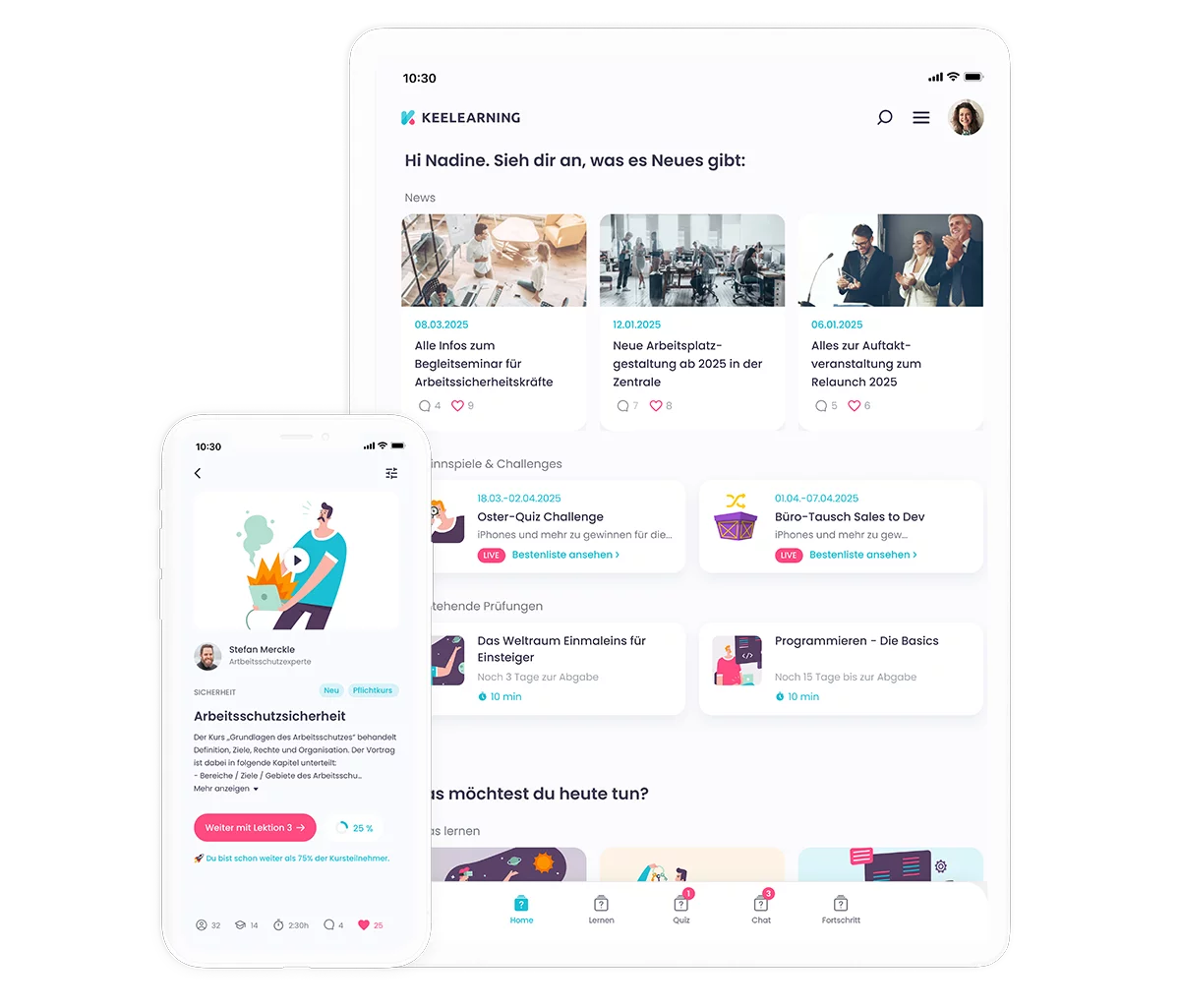
With an authoring tool for your own learning content , departments can more easily translate their expertise into learning formats. For recurring topics, ready-made courses and learning templatesalso help.
Introducing collaborative knowledge management: step by step
The best way to get started is for companies to begin small and scale strategically.
Step 1: Assess your knowledge culture
Before introducing a tool, those responsible should honestly assess the situation: Do employees already share knowledge openly? Are questions valued or seen as a sign of weakness? Are there silos between departments, locations, or shifts?
Collaborative knowledge management only works if participation is encouraged. Managers play a key role here. They should welcome questions, publicly acknowledge contributions, and actively participate themselves.
Step 2: Choose an entry point
Start where the benefits are quickly visible. Suitable entry points include:
- Onboarding new employees
- Recurring questions from teams
- Communication between locations
- Product knowledge
- Workplace safety
- Customer service best practices
- Lessons learned from projects
- Shift handovers or operational insights
The more specific the starting point, the easier it is to encourage participation.
Step 3: Launch a pilot project
Choose a team, a target group, or a topic. For example, start with a knowledge community for new employees or a community for branch managers.
Define clear rules:
- What kind of contributions are encouraged?
- Who will moderate?
- How are high-quality answers marked?
- Which content will be incorporated into courses or FAQs?
- How will feedback be used?
Step 4: Make participation easy
Collaboration often fails due to barriers that are too high. Employees should be able to create content quickly, ask questions easily, and find answers without hassle.
Helpful features include:
- mobile access
- short posts
- comments and reactions
- simple search functionality
- notifications
- clear topic categories
- multilingual content
- visible points of contact
International teams in particular benefit from automatic translation for multilingual teams.
Step 5: Scale and measure
After the pilot, those responsible should review what worked:
- How many questions were asked?
- Which posts were used most frequently?
- Which topics are missing?
- Which content was improved?
- What training sessions resulted from this?
- Where do knowledge gaps still exist?
These insights allow collaborative knowledge management to be scaled to additional teams, locations, or topics.
Request a free demo now
A comparison of collaborative knowledge management tools
The following overview does not replace an individual vendor assessment, but it does provide a helpful starting point.
Disclaimer: The research for this comparison was conducted in July 2026. We strive to keep all information as current as possible and update it regularly. However, if you would like to familiarize yourself with our competitors' offerings, you should view them via their official websites or contact a representative.
|
Tool |
Typ |
Stärken |
Geeignet für |
|
LMS mit Community, Chat, Mediathek und Lernfunktionen |
verbindet Wissensteilung, Lernen, mobile Nutzung, Übersetzung und Auswertung |
Unternehmen, die kollaboratives Lernen und Wissensmanagement kombinieren möchten |
|
|
Wiki und Dokumentation |
strukturierte Wissensartikel, Seiten, Vorlagen, Zusammenarbeit |
Teams mit Fokus auf Dokumentation und Projektwissen |
|
|
Kollaboration und Kommunikation |
Chat, Kanäle, Meetings, schnelle Abstimmung |
Unternehmen, die Austausch im Microsoft-Umfeld organisieren |
|
|
Workspace und Wissensdatenbank |
flexible Seiten, Datenbanken, Vorlagen, Teamwissen |
kleinere Teams mit flexibler Dokumentation |
|
|
Q&A-Wissensplattform |
Fragen, Antworten, Expertenwissen, technische Communities |
technische Teams mit starkem Frage-Antwort-Fokus |
keelearning for collaborative knowledge management
keelearning combines collaborative knowledge management with learning. This allows the platform to go beyond a simple repository or wiki: knowledge is not just stored, but shared, taught, and verified.
Particularly relevant are:
|
Ziel |
keelearning-Funktion |
Nutzen |
|
Wissen gemeinsam erstellen |
Autorentool |
Mitarbeitende und Fachbereiche erstellen eigene Kurse und Lerneinheiten |
|
Wissen teilen und diskutieren |
Gruppen, Beiträge, Kommentare, Feedback und Austausch |
|
|
Wissen bewahren |
Dokumente, Videos, SOPs, Betriebsanweisungen und News an einem Ort |
|
|
Lernerfolg messen |
Quizze, Tests und Auswertungen |
Wissenslücken werden sichtbar |
|
Mitarbeitende mobil erreichen |
App für iOS und Android |
Auch Frontline-Teams ohne Desktop-Zugang können teilnehmen |
|
Sprachbarrieren reduzieren |
automatische Übersetzung |
Inhalte werden für internationale Teams leichter zugänglich |
This connection is especially important for companies with decentralized teams, multiple locations, or operational staff. Knowledge is created where the work happens. At the same time, it must be structured so that others can understand, find, and apply it.
Knowledge is most powerful when it is shared
Collaborative knowledge management changes the role of employees. They are not just recipients of information, but active contributors of knowledge. This is exactly what creates a dynamic knowledge cycle: questions are asked, experiences are shared, content is improved, and new solutions become visible.
In the future, AI will also play a larger role. Automatic summaries, intelligent recommendations, or AI-supported course creation can help translate knowledge from communities into usable learning formats more quickly. Nevertheless, the most important success factor remains human: employees must be willing to share their knowledge.
With keelearning, companies can combine collaborative knowledge management, social learning, community, media library, mobile access, multilingualism, and reporting. This ensures that knowledge is not just collected, but built, applied, and developed together.
Schedule a demo and experience collaborative knowledge management live
FAQ: Collaborative Knowledge Management
What is collaborative knowledge management?
Collaborative knowledge management means that knowledge within a company is created, shared, discussed, and developed collectively. Employees are not just recipients, but active participants in the knowledge process.
How does collaborative knowledge management differ from traditional knowledge management?
Traditional knowledge management is often organized top-down: knowledge is created and stored centrally. Collaborative knowledge management involves employees more actively. Knowledge also emerges bottom-up through questions, contributions, experiences, and joint development.
Which methods are suitable for collaborative knowledge management?
Communities of practice, peer learning, peer case consultation, mentoring, reverse mentoring, after-action reviews, lessons learned, and user-generated content are all suitable options.
Which tools support collaborative knowledge management?
Wikis, community platforms, collaboration tools, and LMS platforms with social features are all suitable. The right solution depends on whether knowledge is simply being documented or also needs to be learned, tested, and analyzed.
How do I introduce collaborative knowledge management for frontline teams?
Start with a specific problem, such as onboarding, shift handovers, or recurring questions. Use mobile-friendly formats, short content, clear topic areas, and multilingual information. It is also important to highlight high-quality contributions and convert them into learning content or FAQs. keelearning is particularly well-suited for this.
Table of Contents
Ready for training that works?
Get to know keelearning in a personal demo – no obligation and tailored to your needs.





The learning platform for businesses looking to make their training simple, mobile, and accessible to all – with no IT overhead.