All blog posts
Published on
20.05.2026
Scaling customer training: Why growing companies fall into the trap with their training

Lisa Kubatzki
Senior Content Marketing Manager @ keelearning
description

More customers, more chaos? When your success slows you down – and how to get out of it.
It sounds like a contradiction: You win new customers, your product is bought more and more often – and yet something is going fundamentally wrong.
The customer onboarding takes weeks instead of days. The support inbox is growing faster than your team. Your best trainers are fully booked for months. And new customers have barely started before they are frustrated for the first time.
Welcome to the growth trap.
The paradox: Success leads to slowing down
Most companies train their customers the way they have always done: personally, live, individually. One trainer per customer. One training session per onboarding. One explanation per support ticket.
That works – until it no longer works.
Because this model has a fundamental problem: It doesn't scale. With every new customer, the effort grows linearly. Ten customers mean ten training sessions. One hundred customers mean one hundred training sessions. And somewhere along this path, the system collapses.
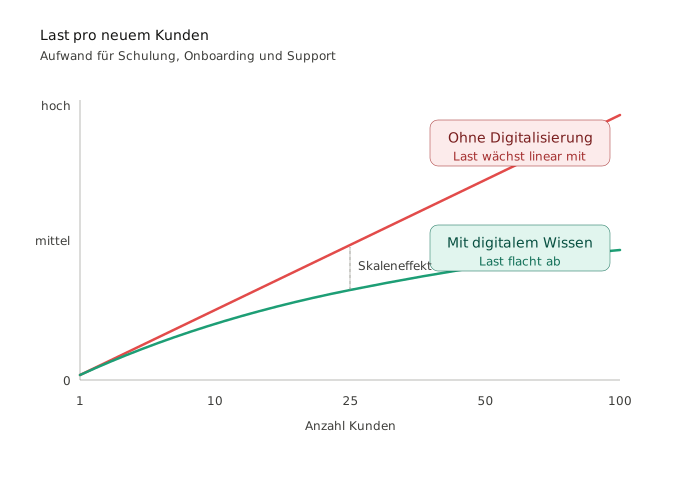
Precisely when you want to grow the most, you become the slowest.

Do you want to know how the software company DATAflor optimized and scaled its customer training?
Watch our webinar on the topic now!
The most expensive employee in your company
There is one person in almost every growing company who costs an enormous amount – and whose value almost no one questions.
It is the person who explains the same thing to customers over and over again.
Their entire working day consists of repeated explanations. Again and again, the same features, the same introductory questions, the same onboarding steps. Every new customer costs exactly as much effort as the first. There is no economy of scale, no efficiency gain, no relief.
And that is not this person's fault – it is a structural problem.
What that means in concrete terms
If customer training doesn't scale, it has direct consequences on four levels:
1. Onboarding takes too long
Customers have to wait for appointments. They start slowly. And in the time until the first real usage, the probability increases that they ask themselves: Do I really need this?
2. The best trainers become a bottleneck
Experienced employees spend their time on repetitions instead of value-adding tasks. And when they leave the company, the knowledge leaves with them.
3. Customers don't get into the "doing"
Anyone who does not quickly experience the first success with a product loses motivation and trust. The result: churn that could have actually been avoided.
4. Support overflows with avoidable questions
Many tickets are created not because the product is bad – but because customers never really got to know it properly. Good training is more effective than any FAQ article.
ROI of customer training: What the numbers say
A Forrester study from 2024 examined what happens when companies invest in structured customer training. The results:
- +38% higher product adoption
- +35% higher customer lifetime value per trained user
- +29% higher win rates
- +26% higher customer satisfaction
- –15% lower support costs
The core logic behind this is simple: A customer who really understands your product stays longer, uses more features – and costs less in support.
From 1-to-1 to 1-to-N: The way out of the trap
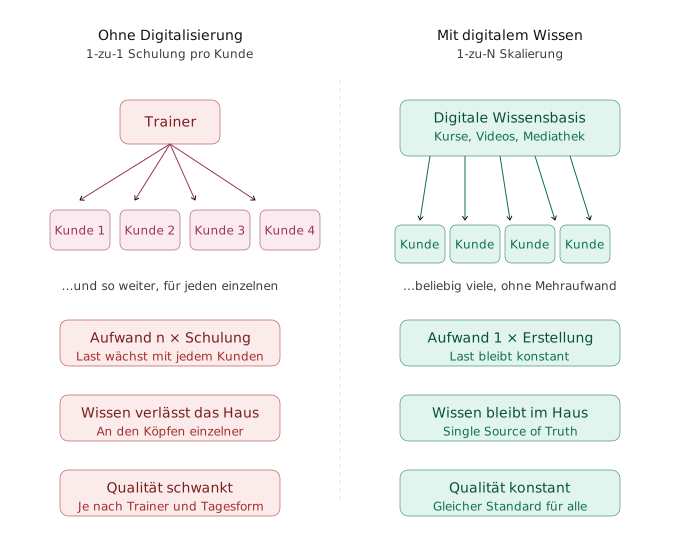
The model that scales works on a different principle.
Instead of one trainer training one customer, a digital knowledge base trains an unlimited number of customers simultaneously. You create the content once – and from that moment on, it is available to every customer, at any time, in any language.
The difference in practice:
Without digitalizationWith digital knowledge baseEffortn × training1 × creationScalingGrows with customer countRemains constantKnowledgeIn the minds of individualsIn-house, as a single source of truthQualityFluctuates depending on trainerConstant for everyone
This is not a future scenario. Companies like dataflor AG – with 4,000 customers, 15,000 users, and over 30,000 support tickets per year – are already living this. Training revenue has doubled since the introduction of a digital customer academy.
When is the right time?
The honest answer: yesterday.
But if you want to start today, you don't need a perfect solution. You need a first course on your most pressing topic, clear accountability – and the willingness to stop doing what no longer works.
In another article, we show you what this looks like in seven concrete steps: [→ In 7 steps to your own customer academy]
Do you want to know what this looks like in practice? Watch our webinar "Success Faster" for your personal customer training framework or book a non-binding demo with keelearning.
Table of Contents
Ready for training that works?
Get to know keelearning in a personal demo – no obligation and tailored to your needs.
Share
Lorem ipsum dolor sit amet, consectetur adipiscing elit. Suspendisse varius enim in eros elementum tristique. Duis cursus, mi quis viverra ornare, eros dolor interdum nulla, ut commodo diam libero vitae erat. Aenean faucibus nibh et justo cursus id rutrum lorem imperdiet. Nunc ut sem vitae risus tristique posuere.





The learning platform for businesses looking to make their training simple, mobile, and accessible to all – with no IT overhead.