All blog posts
Published on
13.04.2026
Simply clicked through, learned nothing: How to measure learning success & ensure that content is actually learned

Lisa Kubatzki
Senior Content Marketing Manager @ keelearning
description

Your tool indicates: Mandatory training completed. But has your employee really understood the content? Or did they just click "Next" 40 times?
Many L&D managers are familiar with this problem. In theory, they have everything: good training courses, an LMS to document completion rates, and proof of completed training.
And yet, they notice that employees have not understood the content, that what has been taught is not being applied, and that major qualitative deficits emerge in everyday work, which in turn can have serious consequences for business and compliance.
In this article, we will look at what learning managers, HR, and executives can do to measure the learning success of your e-learnings & ensure that your employees *really* learn the training content.
TL;DR:
- High completion rates do not automatically mean learning success & that content has been understood
- Employees who simply click through can reveal critical knowledge gaps during audits, hygiene inspections, or in everyday work
- Conventional learning platforms measure completion, not learning success or understanding
- With the right measures – learning status queries, cloze tests, transfer verification, and gamification – you reliably ensure true learning success
The problem: Clicking through without real learning success
Imagine this: An employee in your food production facility has completed the hygiene training. Box checked, proof in the system. Two weeks later, the food authority finds serious hygiene deficiencies during an unannounced inspection – and the employee cannot name basic regulations that were actually part of the training.
Or another scenario: Your company is facing a compliance audit. All mandatory proofs are available. But interviews quickly reveal that the employees have not internalized the content. They do not know why certain processes run the way they do. The audit ends with objections – despite complete documentation.
These situations are not exceptions. They are the logical consequence of a structural problem: Many learning platforms measure the completion of a training course, not the understanding behind it. Whoever clicks "Next" 40 times is considered finished. That may be enough for the statistics – not for the emergency case.
The consequences can be significant: regulatory objections and fines, damaged reputation with customers and partners, liability risks for executives and the company, as well as avoidable errors in everyday work that endanger quality, safety, or customer satisfaction. Especially in regulated industries like food, pharma, chemicals, or financial services, this is not a theoretical consideration, but a real risk.
Why conventional learning platforms do not show failures
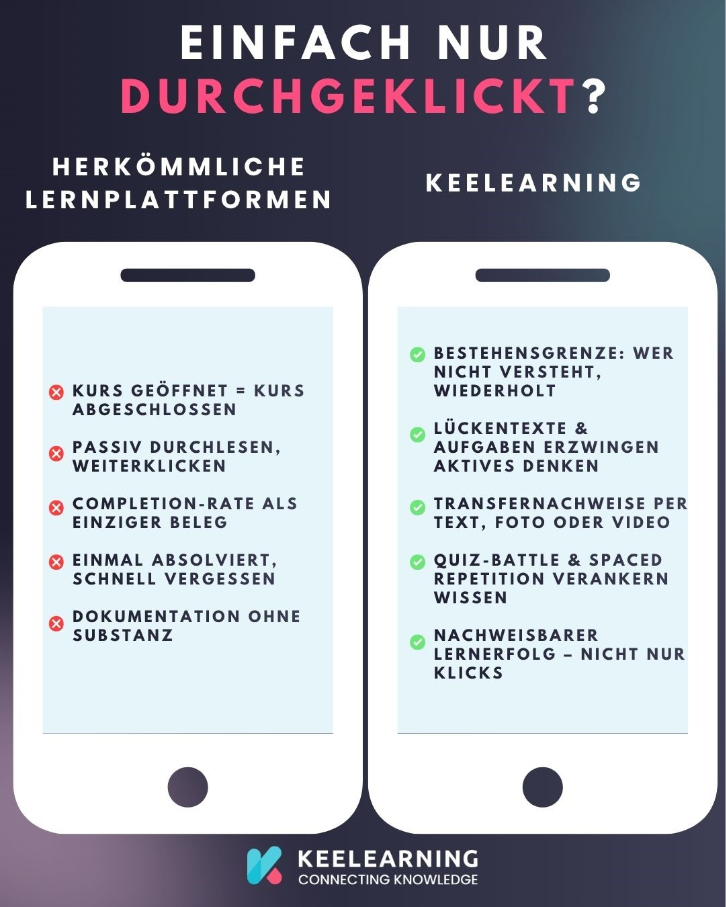
Companies acquire an e-learning platform to get a better overview of who has completed which training courses. The hope is to be able to scale and professionalize their human resources development, and yet many of these learning platforms have a blind spot:
They allow learners to skip content or interact minimally. Training managers thus cannot be sure whether content has actually been understood. A transfer of what has been learned into actual everyday work is therefore not guaranteed.
This is a real compliance and quality problem – especially in regulated industries. A documented training completion only protects you legally and regulatorily if you can also prove in case of doubt that the content has been understood. Anyone who can only show completion rates during an audit, but no evidence of actual knowledge acquisition, quickly faces a problem. Authorities, certification bodies, and auditors are not interested in whether a course was opened – they are interested in whether the knowledge exists.
The pure completion rate says nothing about learning success. It is a process metric, not a result metric. It shows that someone started and finished a training course – nothing more. Companies that look exclusively at completion rates are optimizing for a key figure that, in the worst case, creates deceptive security. Real quality assurance in human resources development begins where what employees actually know and can apply is measured.
The solutions: How to ensure that training REALLY gets through
Before you despair now: You have already taken the first step. You have recognized the problem. And there are solutions - measures you can take to make sure that your future training courses are actually completed and internalized!
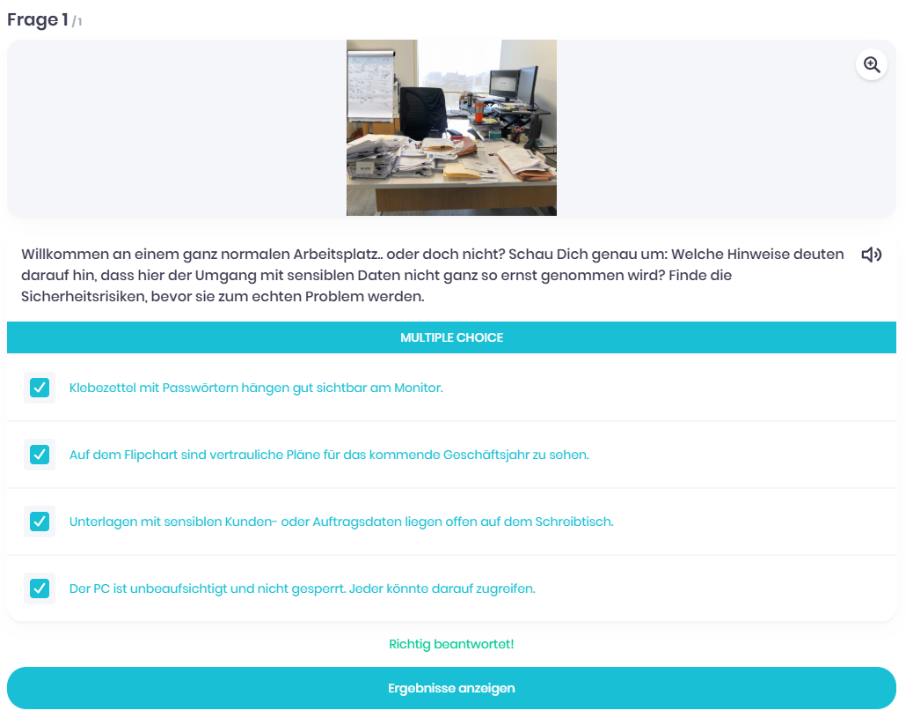
1. Learning status queries with passing threshold
Establish quiz questions directly in the course that learners must answer before they can move on. An adjustable passing threshold ensures that content is not just consumed, but understood. Anyone who does not reach the limit must repeat.
At keelearning, learning status queries look like this, for example:
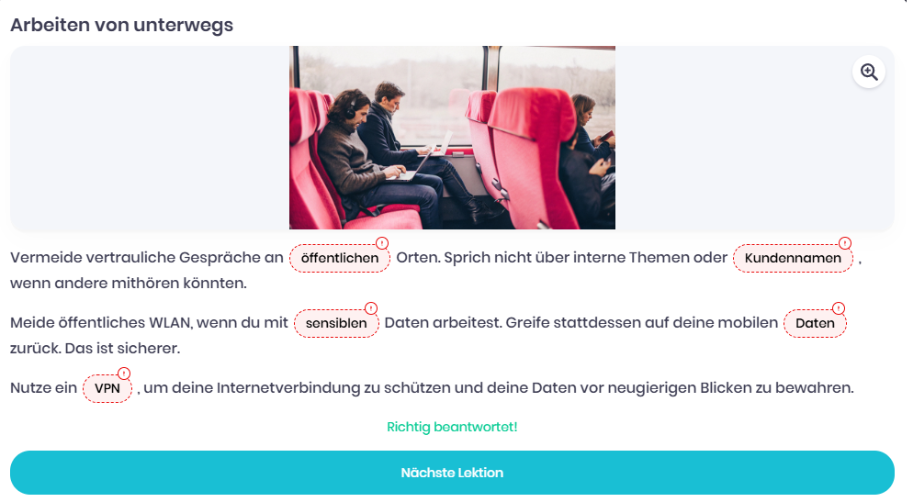
2. Cloze texts in the content
Instead of clickable content & passive reading, learners are actively involved: missing terms must be added by themselves. This increases cognitive processing and shows directly whether what was read has been understood.
In keelearning, you can easily integrate cloze texts into your courses:
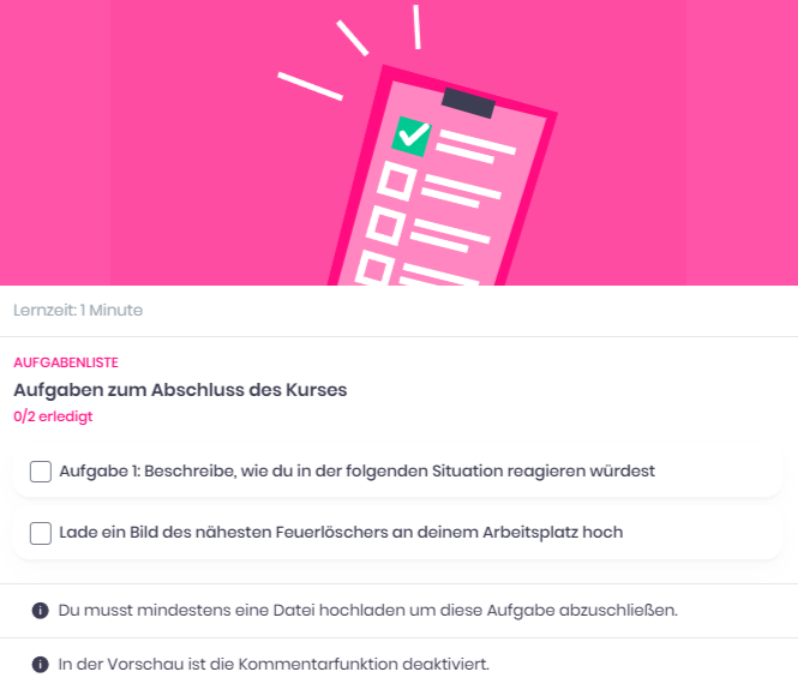
3. Mandatory submission tasks
Learners submit tasks - as text, photo, or video. Only then do they fully complete the training. This is particularly valuable for practical transfer evidence: Show how you have applied what you have learned in everyday work. Training managers view and evaluate the submissions.
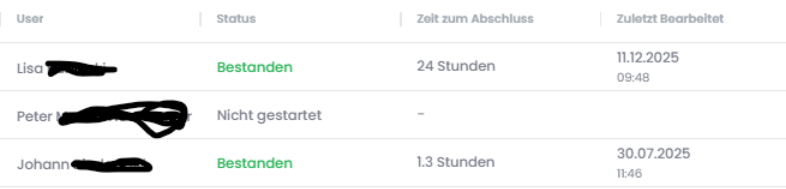
4. Recording of learning time
The actual time learners spend in the course is measured. This makes it possible to see whether someone has really worked through the content - or whether the course was completed in an unusually short time.
In the analytics dashboards of keelearning, the recording of learning time looks like this:
5. Repetition through quiz battle & individual mode
https://www.youtube.com/watch?v=8Dw7HWZYP8M
Gamification of training is THE keyword to manage the transformation from clickable mandatory content to interesting training content.
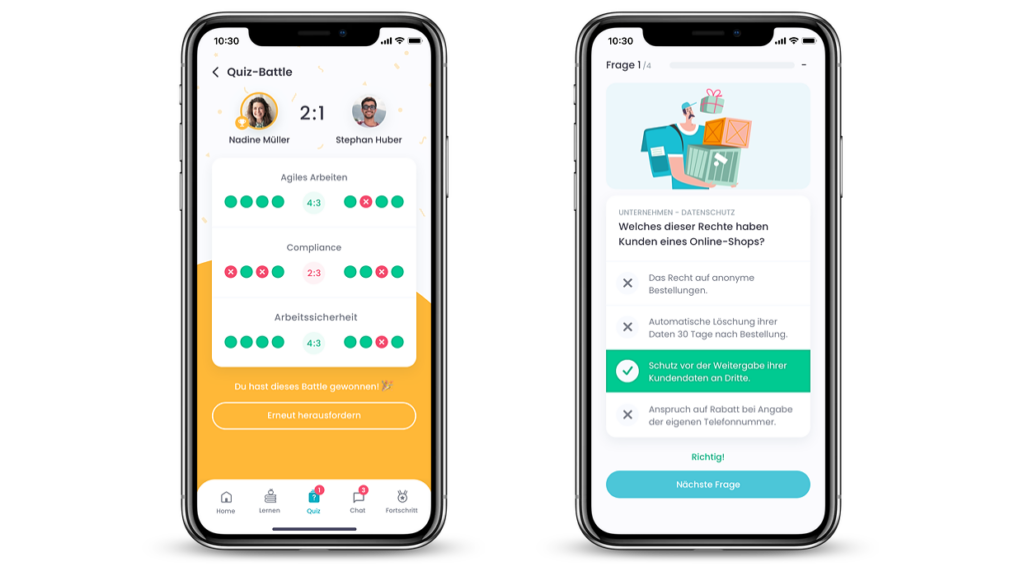
At keelearning, we rely on spaced repetition in a playful way: in the quiz battle, learners compete against each other, and in individual mode, they repeat independently. Both formats help to anchor knowledge in the long term - not just to retrieve it in the short term.
6. Practical transfer evidence
The strongest proof of genuine learning success: learners document how they have applied what they have learned - via free text, photo, or video. This closes the gap between theoretical knowledge and practical application. Yes, this is how you extend the times in which a training course is completed, but with a transfer proof, you can really be sure that learners have engaged with the content.
Do you want to see all these features in action and find out if they also work for your company? Then book a non-binding demo with keelearning now.
Mandatory video as a false friend
Not every measure for learning control is sensible. Many training managers expect that a mandatory video requirement – i.e., the technical forcing of watching a video to the end – is the solution to the problem of non-internalized content. However, such a requirement is rather counterproductive.
Why? Anyone who has already mastered the content will be demotivated and annoyed by such a requirement. This damages the learning culture as a whole.
The better solution is to quiz knowledge instead of forcing time. The focus should be on the result (is knowledge available?), not on the process (was the video played completely?).
Measure learning success correctly: How to ensure that training really gets through
Clicking through is not learning. And a checkmark in the system is not proof that your employees are prepared for an emergency.
With keelearning, you can design training courses in such a way that knowledge really gets through: with embedded learning status queries, cloze texts, transfer evidence, and playful repetition formats that anchor content in the long term – instead of checking them off once.
The result: training content that is not just documented, but actually understood. For more safety in everyday life, during audits, and wherever it really matters.
Get to know keelearning in a personal demo – and see for yourself what sustainable learning looks like in practice.
Key Takeaways
Table of Contents
Ready for training that works?
Get to know keelearning in a personal demo – no obligation and tailored to your needs.
Share
Lorem ipsum dolor sit amet, consectetur adipiscing elit. Suspendisse varius enim in eros elementum tristique. Duis cursus, mi quis viverra ornare, eros dolor interdum nulla, ut commodo diam libero vitae erat. Aenean faucibus nibh et justo cursus id rutrum lorem imperdiet. Nunc ut sem vitae risus tristique posuere.





The learning platform for businesses looking to make their training simple, mobile, and accessible to all – with no IT overhead.