All blog posts
Published on
14.05.2019
Employee training methods: Ideas on how to convey (mandatory) topics in a more motivating way

Norma Demuro
E-Learning Expert, CEO @ keelearning
description

It has been about a year since the General Data Protection Regulation (GDPR) came into force. But employers have more to communicate to their employees than just the GDPR topic: From saving energy in offices to hygiene regulations in gastronomy, to fire safety and security instructions, there are many topics that are important in the context of employee training – but often not particularly exciting for staff. What can companies do to ensure that staff truly internalize important facts?
5 ideas for the motivating delivery of mandatory training
1.) Digital employee training
Mandatory training does not necessarily have to take place in a seminar room. Thanks to digitalization and modern e-learning solutions, you can also offer these as a digital e-learning course (also called web-based training). The advantages:
- Learning independent of time and location
- No travel and accommodation costs
- Learning at one's own pace
- More fun through exercises and interaction
- Flexibility through fast-forwarding and rewinding
This is what digital mandatory employee training looks like:
2.) Gamification: Promoting healthy knowledge competition via quizzes
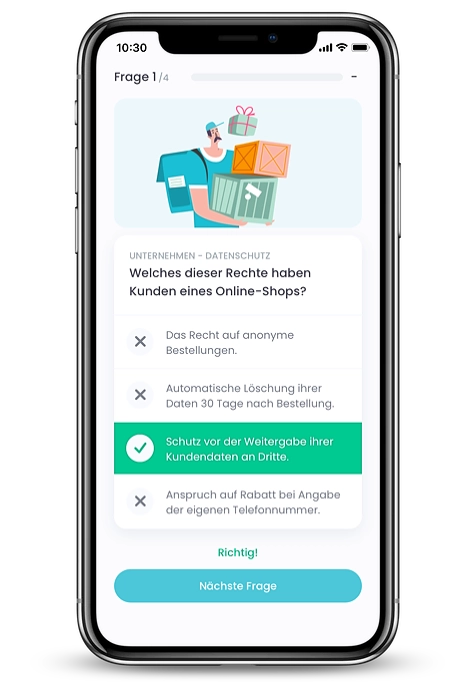
Acquiring knowledge is much more fun when you do it together and can show what you have learned. It is not without reason that quiz shows are very popular on television. The playful element is also popular in a professional context. Thanks to gamification, even dry content can have a fun factor.
A quiz app offers several advantages here: The app can be used again and again for mandatory training without having to coordinate appointments. Certificates are sent automatically, which additionally saves organizational effort. In sales field services or other decentralized structures, a quiz app can facilitate learning news about products and services independent of time and location.
- More on the topic of quiz app for your employee training.
3.) Blended Learning: Providing employees with individual learning opportunities

It is demonstrably motivating for skilled workers when they are neither under-challenged nor over-challenged during employee training. Blended learning, i.e., hybrid learning, provides a remedy here. A mix of online and offline training makes it possible to bring employees up to the same level of knowledge digitally before a seminar or to deepen content individually after a seminar, independent of time and location, wherever they need it.
- Here you will find all information on Blended Learning.
4.) Microlearning: Effectively conveying content through small units
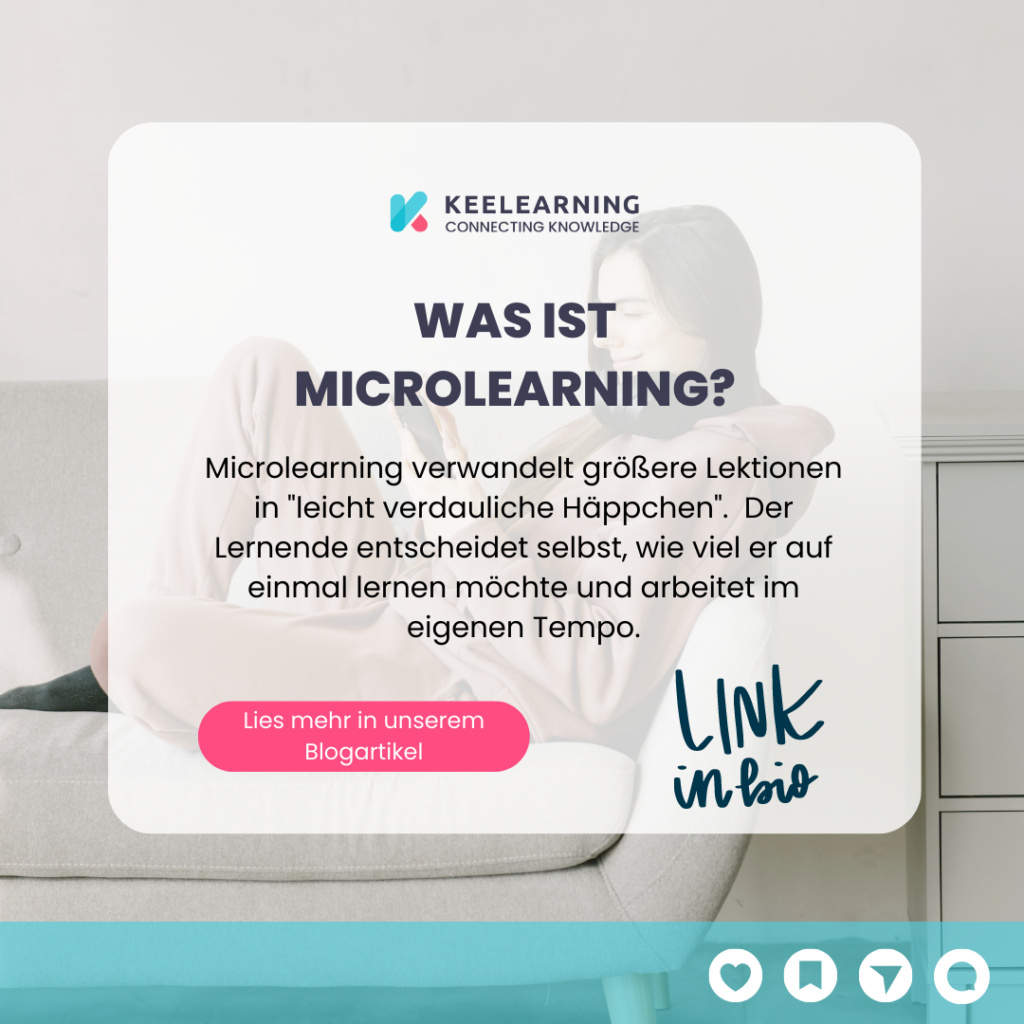
Microlearning has been a trend for some time. Especially in times of information overload, lack of time, and ever-faster processes, this continues. Because the human attention span is getting shorter. In the internet, the first 5 to 10 seconds of a video already decide whether it will continue to be watched. Social media channels fuel the changed flow of information absorption. The changed user behavior is also transferring to learning in vocational training and further education, right up to adulthood. Microlearning promotes the internalization of content through frequent repetition of content in small chunks. Flashcards, interactive cards, or short learning videos are just a few examples of the creative implementation of micro-content.
- Find out more in our series on microlearning.
5.) LMS / Learning App for companies: Strengthening commitment and increasing motivation
Learning in a corporate context is often difficult not least because the timing is wrong, it temporarily has no priority in day-to-day business, or it is immediately forgotten after returning from a seminar. A Learning Management System (LMS) can fix these problems. On the central learning platform, all content is always kept up to date and can be accessed at any time and from any place. The content is prepared using modern methods in such a way that it continuously accompanies, appropriately supports, and binds employees to the company. Perfect, therefore, for employer branding as well.
- Find out more about the LMS here.
Costs for employee training
The costs of employee training depend on the following factors:
- Number of employees
- Frequency of training
- Type of employee training
- Costs for travel and accommodation
- Allowances if applicable
So, it is not possible to state a flat rate for how high the costs per employee training actually are.
Types of employee training
Employee training is already important during onboarding. After all, you benefit greatly when your staff is quickly ready to work. In this context, the aforementioned examples for mandatory training are quickly used. But further training is also relevant over time: be it in the form of professional development, retraining, or extra-occupational training, as well as soft-skill training, which is imparted in the form of key qualifications. In some areas, such as sales, continuous learning of product information and innovations is even a decisive success criterion for the entire company.
Checklist: 7 tips for successful employee training
1. Continuously consider training in your personnel planning and secure budgets for this.
2. Talk to individual employees and think together about where they want to develop.
3. Plan topics that could be important at regular intervals, e.g., saving energy, updates on the GDPR, environmental protection.
4. Find the right format: In-house training, external seminars or workshops, public congresses or conferences, or e-learning offers.
5. Consider whether content could be conveyed digitally as a supplement to employee training within the framework of blended learning.
6. Think about different levels of knowledge and target groups: Meet employees where they are and do not over- or under-challenge them.
7. Make the results of the employee training measurable – this is of course easier in e-learning, but you should also create possibilities for analog training (e.g., through feedback forms).
Would you like to learn more about e-learning and the effective use of digital learning offers? Then download our free eBook now:
Free Download eBook: Strategic E-Learning Planning in 10 Steps
The reader explains step-by-step what you need to pay attention to if you want to implement e-learning offers in your company.
What methods are there for employee training?
Employee training methods differ primarily in how knowledge is conveyed, practiced, and secured. For L&D managers and HR professionals, the decisive question is therefore not which method is particularly popular. The decisive factor is which method fits the learning goal, the target group, and the everyday work life.
A good training strategy usually combines several methods. An example: New employees first receive digital onboarding modules, work through short knowledge checks, and then deepen open questions in a live appointment. This creates a learning process that is clearly structured and still leaves room for individual questions. Read here how you can train employees online with keelearning.
Which methods are really effective?
Effective employee training methods have one thing in common: they get people into action. Knowledge is not just consumed, but understood, applied, and repeated.
In practice, those methods that meet three criteria are particularly effective:
- They fit into the everyday work life
Training works better when it is not experienced as an additional burden. Short digital modules, mobile learning content, or microlearning units are easier to integrate into full working days than long training days. - They activate the learners
Pure listening is rarely enough. Quizzes, case studies, short tasks, scenarios, or reflection questions ensure that content is processed. This increases the probability that knowledge will be retrievable in everyday work life later on. - They secure knowledge long-term
One-off training courses quickly fizzle out if content is not repeated afterwards. Effective methods therefore work with repetition, small learning impulses, and measurable knowledge checks.
Therefore, the following are particularly effective:
- Microlearning, when content should be understood quickly and refreshed regularly
- Gamification, when dry mandatory content should be conveyed in a more motivating way
- Blended Learning, when knowledge should first be built up and then practically deepened
- E-Learning with knowledge checks, when learning progress must be traceable
- mobile training, when teams do not work at a desk permanently
Read in our short article how you can design interactive training.
How do you structure employee training that is actually completed?
Many training courses do not fail because of the topic. They fail because they are too long, too abstract, or too far removed from everyday work life. If employees experience training as a mandatory appointment without concrete benefit, motivation drops. That is why good employee training needs a clear learning logic.
1. Start with the concrete goal
Before content is created, it should be clear what should be different after the training. A good goal formulation is not: "Employees should be informed about data protection." It is better to say: "Employees recognize personal data in everyday work and know how to handle it correctly."
Helpful guiding questions are:
- Which task should employees perform more confidently after the training?
- Which mistakes should be avoided?
- Which questions should no longer arise in everyday life afterwards?
- Which standards must everyone know?
The clearer the goal, the more focused the training becomes.
2. Divide content into small units
Long training sessions often appear comprehensive but are difficult to remember. Short, clearly defined modules are better. Each module should answer exactly one question or solve a concrete problem.
Example for a product training:
- What is the product?
- For which clientele is it suitable?
- Which three advantages should be mentioned in the sales talk?
- What follow-up questions often arise?
- What does a good consultation look like?
This creates a learning path that is logically structured and easy to complete.
3. Make the benefit visible
Employees are more likely to complete training if they understand why the topic is relevant. Therefore, do not start with rules, but with an everyday situation.
Instead of: "In this training, you will learn the new hygiene standards."
Better: "A small mistake during cleaning can lead to products not being allowed to be sold. In this training, you will learn which three steps you must comply with safely every day."
The difference is clear: the second version immediately shows why the training is important.
4. Use interaction instead of pure knowledge transfer
Training becomes stronger when learners become active regularly. This does not always require elaborate learning formats. Even small elements help:
- Multiple-choice questions after a short section
- Practical cases with decision options
- Before-and-after examples
- short reflection questions
- Mini-quizzes for repetition
- Checklists for direct application
This turns passive consumption into an active learning process.
5. Remind specifically about open training
Even good content is overlooked in everyday work if there is no clear communication. Therefore, plan with:
- Initial communication by managers
- automatic reminders
- clear deadlines
- short explanation of the benefit
- transparent information about the time required
A sentence like "This training takes 7 minutes and helps you to apply the new return policy safely" is much more concrete than a general request to participate.
How do you secure knowledge among employees long-term?
Sustainable knowledge retention does not come from a single training session. It comes through repetition, application, and easy availability. Especially with mandatory training, process knowledge, or product topics, it is rarely enough to explain content once.
Plan repetition
People forget content if it is not applied or repeated. Therefore, important topics should be refreshed regularly. This can happen via short quiz questions, monthly learning impulses, or small refresher modules.
Example:
- Week 1: Basic training
- Week 2: short quiz
- Week 4: Practical case
- Month 3: Refresher module
- Month 6: Knowledge check
As a result, knowledge remains present without the need for another long training session.
Provide knowledge centrally
Training documents lose their value if they cannot be found later. A central learning platform or media library helps to make content permanently available. Employees can look things up as needed, watch videos again, or call up checklists.
This is particularly important for operational teams. Anyone working on the floor, in production, in service, or in care needs knowledge that is quickly, understandably, and mobilely available.
Involve managers
Training has a stronger effect when managers actively support it. This does not mean that they have to conduct every training themselves. It is decisive that they explain the benefit, enable participation, and pick up on content in everyday life.
Examples:
- short reminder in the team meeting
- Asking about open questions
- observing application in everyday work
- positive feedback for safe implementation
- making learning progress visible
This way, training is not perceived as an isolated task, but as part of daily work.
Employee training ideas for different application cases
Not every training needs the same format. These ideas help with selection:
Mandatory training
Mandatory training appears more motivating when it is short, interactive, and concrete. Instead of long rule texts, short scenarios, quiz questions, and case studies are suitable.
Suitable formats:
- Microlearning
- Quiz app
- digital mandatory instruction
- Certificate after completion
- short refresher modules
Onboarding
Onboarding is about orientation and operational security. New employees do not need all information at once. They need the right content at the right time.
Suitable formats:
- digital learning paths
- Checklists for the first working days
- short videos on tools and processes
- Knowledge checks after important modules
- mobile reference content
Product training
Product knowledge must be current, understandable, and quickly accessible. Especially in sales, service, or support, it is important that employees can confidently explain the benefits a product offers.
Suitable formats:
- Product cards
- short explanatory videos
- Consultation scenarios
- Quiz questions on product benefits
- Updates on new functions
Automate your product training with keelearning
Process training
Processes are best learned when they are explained step by step. Long process documents are often less suitable for this than clear workflows with examples.
Suitable formats:
- Step-by-step instructions
- Process videos
- Checklists
- Practical cases
- short tests on application
What does employee training cost?
The costs for employee training depend heavily on the format, the number of participants, the frequency, and the creation effort. Face-to-face training often causes costs for rooms, travel time, downtime, and external trainers. Digital training, on the other hand, initially requires a concept, content, and a suitable platform, but can then be reused much more easily.
A realistic cost plan should consider these factors:
- How many employees need to be trained?
- How often is the training repeated?
- How frequently does content change?
- Is the training created internally or produced externally?
- Does learning progress need to be documented?
- Are there multiple locations or target groups?
Here you can find a price overview for keelearning.
From training to sustainable knowledge transfer
Good employee training methods do not just convey information. They help people to act more confidently, make better decisions, and apply knowledge at the right moment. Therefore, it is worth planning training not as individual appointments, but as a repeatable learning process.
Anyone who structures content clearly, uses digital formats sensibly, and secures knowledge regularly creates more than just a completed training session. A system is created that supports employees in their everyday life and relieves companies long-term.
Discover more practical knowledge about e-learning and knowledge management on the LinkedIn profile of keelearning!
FAQ: Employee training methods and ideas
What methods are there for employee training?
The most important methods include face-to-face training, digital training, blended learning, microlearning, gamification, interactive training, learning apps, and LMS-based learning paths. Which method fits depends on the goal, the target group, and the everyday work life.
Which method is best suited for mandatory training?
For mandatory training, digital training with short modules, quiz questions, and certificates is particularly suitable. They are flexible, repeatable, and facilitate documentation. Platforms like keelearning are particularly efficient here.
How can employee training be made more motivating?
Employee training becomes more motivating when it is short, practical, and interactive. Case studies, quizzes, clear learning goals, and a visible benefit increase the willingness to participate.
How often should employee training be repeated?
That depends on the topic. Mandatory and safety topics should be refreshed regularly. Product and process knowledge also need repetition as soon as content changes or errors occur frequently.
How can the success of employee training be measured?
Important key figures are completion rates, quiz results, feedback, need for repetition, error rates in everyday life, and the number of recurring questions. A learning platform facilitates the analysis.
Table of Contents
Ready for training that works?
Get to know keelearning in a personal demo – no obligation and tailored to your needs.
Share
Lorem ipsum dolor sit amet, consectetur adipiscing elit. Suspendisse varius enim in eros elementum tristique. Duis cursus, mi quis viverra ornare, eros dolor interdum nulla, ut commodo diam libero vitae erat. Aenean faucibus nibh et justo cursus id rutrum lorem imperdiet. Nunc ut sem vitae risus tristique posuere.




The learning platform for businesses looking to make their training simple, mobile, and accessible to all – with no IT overhead.