All blog posts
Published on
23.11.2026
Safety training for employees with limited German: How to make sure it gets through

Lisa Kubatzki
Senior Content Marketing Manager @ keelearning
description

The safety briefing has been held and everyone has signed. But did everyone actually understand what it was about? If part of your workforce speaks only limited German, the honest answer is often: you don't know.
The short answer: Safety training has to be understandable for employees, which is what German occupational safety law requires. For employees with limited German, that means content in their language, short and visual, with comprehension questions instead of just a signature. A learning platform with automatic translation makes this feasible across many languages and locations.
How common this is surprised even us: in our conversations with 32 companies in October 2026, 11 needed multilingual training, from logistics and production to retail chains.
{{key-takeaways}}
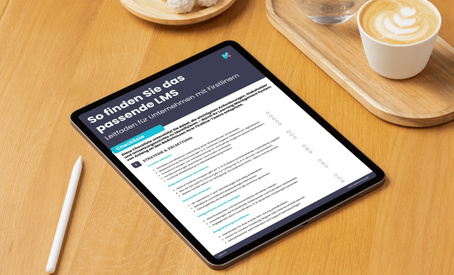
The right LMS for frontline workers
What the law requires
Section 12 of the German Occupational Safety and Health Act (ArbSchG) obliges employers to instruct employees “sufficiently and appropriately” (“ausreichend und angemessen”). The training must be tailored to the workplace or area of responsibility and take place before work begins, as well as when tasks change and when new work equipment is introduced.
The German Ordinance on Industrial Safety and Health (BetrSichV) is even clearer: under Section 12, information about work equipment must be provided “in a form and language that employees can understand” (“in einer für die Beschäftigten verständlichen Form und Sprache”). Training that is not understood does not meet this requirement, even if the signature list is complete.
Important for companies using temporary staff: with temporary agency work, the duty to provide training lies with the hirer, meaning you as the company where the person works. Note: This article provides an overview and does not constitute legal advice.
Why traditional safety training fails here
- Presentation in German, signature in German. People who can’t follow the language nod along and sign anyway.
- A colleague translates on the side. Well meant, but nobody knows what exactly was translated and what got lost.
- Too much text at once. Long slides and technical terms overwhelm even native speakers, let alone people who are still learning German.
- Shifts, locations, turnover. New employees and temporary staff join constantly and wait for the next session, often without an email address or a PC.
Four approaches compared
There is no single right method. In practice, a combination works best, depending on the topic and audience:
| Method | Useful for | Limitation |
|---|---|---|
| Interpreter or colleague translating on site | Individual new employees, hands-on instruction at the machine | Depends on one person, hard to prove what exactly was translated |
| Translated PDFs and notices | Operating instructions that must be displayed at the workplace | Rarely read, no proof that content was understood |
| Pictograms and short videos | Safety rules, protective equipment, procedures | Do not replace explanations for complex topics |
| Learning platform with automatic translation | Recurring mandatory training across many languages and locations | Safety-relevant content should be reviewed by an expert |
For recurring mandatory training in several languages, a learning platform is usually the most cost-effective option: content is created once and delivered in all required languages. Hands-on instruction at the machine or workplace stays on site, while the basics are delivered digitally.
5 rules for training that gets through
- In the learners’ language: Find out which languages your workforce actually speaks and offer content in those languages.
- Short and simple: Units of a few minutes, short sentences, technical terms explained rather than assumed.
- Show, don’t describe: Photos of your own workplace, pictograms and short videos say more than a paragraph of text.
- Check understanding: Two or three quiz questions in the respective language show whether the key message has landed.
- Access without hurdles: Learning via app on a smartphone, login via code or QR code instead of company email. More in our glossary under voucher code.
Automatic translation: what to look out for
AI translation is what makes multilingual safety training practical, because each language version no longer has to be commissioned separately. To ensure quality, the platform should be able to do four things:
- Post-editing: Subject matter experts can review and correct every language version.
- Defining technical terms: Terms such as product names or names of protective equipment are always translated the same way, or not at all.
- Tracking changes: When the original changes, you can see which translations still need updating.
- Translating everything, not just the course: Navigation, notifications, quiz questions and the certificate are part of it.
With Autotranslate, keelearning uses AI to translate courses, learning paths, quiz questions, news, the media library and chat into more than 20 languages, including Arabic, Polish, Turkish and Ukrainian. Language versions can be reviewed and edited directly in the platform, and completion certificates are issued automatically in the learner's language.
{{inline-cta}}
In practice: 600 frontline workers trained in their own language
The Swiss logistics and fulfillment provider MS Direct trains more than 600 frontline employees at 8 locations with keelearning, including process and safety training directly at the workplace. Previously, training was mainly delivered through daily briefings, which reached its limits with so many different languages. Today, employees learn via app in their native language. Read more in the MS Direct case study.
5 steps to multilingual safety training
- Record languages: Which languages are needed at which location? Ask team leads, not just the HR file.
- Prioritize mandatory topics: Start with the training where misunderstandings are most dangerous, such as occupational safety or hygiene.
- Translate and review: Translate content automatically and have safety-relevant passages checked by a qualified person.
- Add comprehension questions: Short questions at the end of each unit, also in the respective language.
- Document completion: Who completed which training, when and in which language? That keeps you on the safe side in an audit as well.
For how to plan the overall rollout in 30 days, read Implementing an LMS: a 30-day plan.
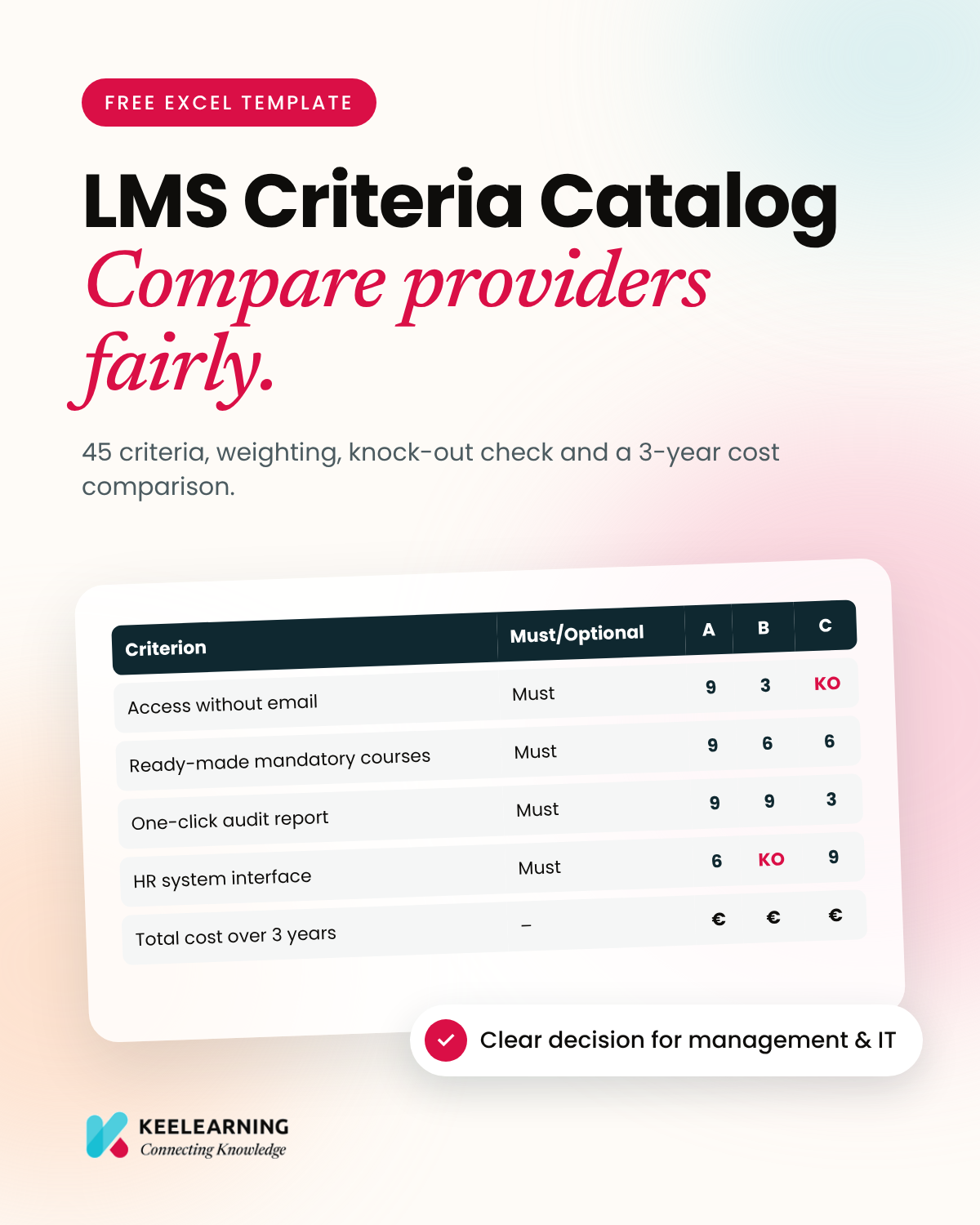
Compare LMS providers fairly
45 criteria, weighting and knock-out check: the template for your LMS selection or tender.
- Questions for demo & trial
- Automatic knock-out check
- 3-year cost comparison
- Questions for management, IT & works council
FAQ: Safety training for employees with limited German
Does safety training have to be in the employee's native language?
Not necessarily. What matters is that employees understand it. The German Ordinance on Industrial Safety and Health (BetrSichV), for example, requires information in a form and language the employees understand. Anyone who does not understand German well should therefore be trained in a language they master.
Is automatic translation enough for mandatory training?
As a basis, yes, because it makes content available in many languages quickly. Safety-relevant content and technical terms should still be reviewed by a qualified person, ideally someone who speaks the target language.
How do I prove that the training was understood?
With short comprehension questions in the respective language and documentation of who completed which training and when. A signature alone only proves attendance, not understanding.
Who trains temporary agency workers?
Under the German Occupational Safety and Health Act, the duty to provide safety training for temporary agency workers lies with the hirer, meaning the company where the person works.
What if employees have no email address?
Use a learning platform with an app and access via code or QR code. In keelearning, for example, this works with a voucher code, without any company email address.
Conclusion: understood is more than signed
Safety training only serves its purpose if it is understood. For employees with limited German, that works with content in their language, short units, images and comprehension questions. A learning platform with automatic translation makes this possible across many languages and locations without much extra effort.
Would you like to see what multilingual safety training looks like with keelearning? We'll show you in a personal demo, with no obligation.
Key Takeaways
- Safety training must be understandable for employees; a signature alone is not enough.
- 11 of 32 companies in our conversations needed multilingual training.
- Short units, images and comprehension questions in the respective language work better than long presentations.
- Automatic translation makes many languages feasible; safety-relevant content should be reviewed.
- With temporary agency work, the hiring company is responsible for the training.
Table of Contents
Ready for training that works?
Get to know keelearning in a personal demo – no obligation and tailored to your needs.




The learning platform for businesses looking to make their training simple, mobile, and accessible to all – with no IT overhead.