All blog posts
Published on
28.01.2026
Collaborative Learning: Definition, Methods and Practical Examples

Lisa Kubatzki
Senior Content Marketing Manager @ keelearning
description

Learning alone can be tedious. We procrastinate, get bored, or just memorize things, only to forget everything quickly as soon as we no longer need it. – Quite impractical, especially when you are supposed to apply what you have learned in your job, and the existence of the company depends on successful training, mandatory training, and successfully imparted knowledge.
For this very reason, collaborative learning is increasingly coming to the fore in the e-learning world. Here is a short definition:
Collaborative learning involves learning in a group. At least 2 people work actively together on a task, a problem, or a project with a common learning goal. The great advantage of collaborative learning is that the learners do not just engage with the subject matter, but at the same time, through community, train both professional and social skills.
Sounds great, right?
Now the big question is, how does collaborative learning work in a corporate context, and how can you implement it? Don't worry, in this article, we'll reveal it to you.
- Learning together instead of alone → Applying knowledge more sustainably
- Exchange, reflection & soft skills strengthen team and creativity
- Methods: Peer Learning, Learning Circles, Problem Solving, Social Learning
- Companies benefit from engagement, cohesion & faster onboarding
- Implement collaborative learning digitally with Keelearning and sustainably secure knowledge in the company
Advantages of Collaborative Learning in Companies
Is it really worth it as a company to engage with methods and tools of collaborative learning? Take a look at these advantages of collaborative learning:
- Intensive & active engagement with the learning material: In collaborative learning, employees are not just consumers of content but actively shape learning processes. Knowledge is anchored more sustainably through explaining, discussing, and applying.
- Dialogue, reflection, and repetition: Exchange within the team promotes reflection and makes implicit knowledge visible. At the same time, natural repetitions occur, which solidify what has been learned and uncover misunderstandings early on.
- Training of social skills / soft skills: Collaborative learning strengthens communication skills, empathy, and feedback competence. These skills are crucial for collaboration, leadership, and a healthy corporate culture.
- Complex problems can be solved better in a community: Different perspectives, experiences, and competencies lead to more well-founded solutions. Especially with complex or new challenges, collective thinking is a clear advantage.
- Space for ideas and creativity: Collaborative learning creates an environment in which ideas can arise and be further developed. Open exchange promotes innovation and encourages employees to contribute new approaches.
- Collaborative learning as a teambuilding measure: Learning in a group strengthens trust, cohesion, and the sense of "we." Teams that learn together work more effectively in the long term and feel more strongly connected to one another. In short: It is simply more fun 😉
Cooperative vs. Collaborative Learning
Cooperative Learning
Division of labor. Everyone learns/works on a part, which is then put together into a result at the end.
Collaborative Learning
Joint learning process. Everyone works together and actively on a goal.
Methods of collaborative learning for Learning and Development in your company
Peer Learning
In peer-to-peer learning, employees share their knowledge and experiences with one another. Learning happens through interaction with each other, e.g., in group projects, partner exercises, or discussions.
Learning Circles
Learning Circles are small, self-organized learning groups that regularly exchange ideas on a common topic. Participants learn from one another, reflect on experiences, and support each other in applying them in everyday work.
Problem-based learning
In problem-based learning, teams work together on real, practical challenges. Knowledge is not taught abstractly, but specifically developed when it is needed to solve the problem.
Knowledge Co-Creation
Employees create wikis, digital whiteboards, and documents together and record their collective knowledge there. This creates living, continuously growing company knowledge that is accessible to everyone.
Curiosity Conversations
Curiosity Conversations are open learning and exchange formats where curiosity is the focus. Employees ask questions, share perspectives, and learn from each other without a fixed agenda or performance pressure.
Remote Coworking
Remote employees meet digitally to work together – an opportunity for exchange and shared focus.
Think-Pair-Share
In the Think-Pair-Share method, participants first think about a question alone, then exchange ideas in pairs, and finally share their findings in the larger team. This combines individual thinking with collective reflection.
The Jigsaw Method
In the Jigsaw method, each person or group works on a part of a larger topic and then contributes this knowledge to the group. Learning thus becomes interdependent and promotes responsibility as well as deep understanding.
Peer-to-Peer Feedback
Instead of getting feedback from supervisors or course instructors, employees give each other feedback at the same level.
Social Learning Platforms
These digital platforms offer the opportunity to exchange ideas online, form digital learning groups, and share knowledge – all on one platform, so that learning doesn't even feel like learning.
Mentoring
In mentoring, experienced employees pass on their knowledge specifically to less experienced colleagues. Learning occurs through exchange, support, and joint reflection – often over a longer period.
Tandem Learning
In tandem learning, two employees learn from each other, e.g., on different specialist topics, roles, or competencies. Both alternately take on the role of the learner and the teacher.
7 Examples of Collaborative Learning in the Company
What does collaborative learning look like in practice? Just imagine the following scenarios:
Example 1: Joint problem-solving in a team
A team is facing a new customer problem or process. Instead of a classic training session, the employees discuss possible solution approaches together in a digital workspace, share experiences, and develop a common best practice.
👉 Learning emerges through exchange, diversity of perspectives, and application – not through pure knowledge transfer.

Example 2: Peer-based onboarding
A group of new employees is not only guided through fixed onboarding courses, but also exchanges ideas in an onboarding group, asks questions, shares initial experiences, and receives feedback from colleagues who are already in the company.
👉 Knowledge is imparted socially; new employees feel integrated and more secure faster.
Example 3: Employee community in the LMS
Imagine a social network for employees of your company. There is a feed. Employees have the opportunity to ask questions, exchange ideas in sub-communities, and share learning successes.
👉 Employees have the chance to network via the learning platform. They get an idea of where others are in the learning process, what questions they have, and are motivated by sharing different learning journeys.
How can you implement this? Keelearning has something prepared for you. With askkeelearning (coming soon!), we give you the opportunity to build a social network and a knowledge base for your company. We already offer you chat, evaluation tools, and coaching opportunities right now. Simply book a non-binding demo and find out how we can shape your company's learning journey.
Example 4: Case studies in learning groups
Instead of just consuming a training session, learners work on real case studies together. Each group contributes its perspective, discusses solutions, and subsequently reflects on the results in the plenary session or in the digital forum.
👉 Learning transfer increases because content is worked out together and critically questioned.
Example 5: Collective knowledge collection
Employees supplement learning content with their own comments, best practices, links, or short explanations. This creates a living knowledge base over time that grows continuously. This can be implemented in the form of a company wiki or a media library.
👉 Learning becomes a dynamic process instead of a completed measure.
Example 6: Mutual feedback on tasks
After a learning module, participants upload their results and receive feedback from colleagues. In doing so, they benefit not only from the feedback but also from reading the solutions of others.
👉 Feedback becomes part of the learning process instead of being solely the task of the trainers.
Example 7: Professional learning groups
Employees with similar roles or interests (e.g., managers, IT, sales) exchange ideas regularly, share challenges, discuss new developments, and learn from one another – supported by digital tools.
👉 Knowledge remains in the company and continues to develop.
Introducing collaborative learning in the company: Step-by-Step
So much for theory: But how do you actually implement collaborative learning in the company? We have put together a small step-by-step guide for you as an orientation.
- Define learning goal
Before formats or tools are chosen, it should be clear what is to be achieved through collaborative learning. Is it about knowledge exchange, problem-solving, skill development, or stronger networking in the team?
- Find the right format
The "right" format for collaborative learning does not depend on a single factor. The decisive factor is the interplay of learning goal, work reality, team structure, and existing learning culture. In practice, hybrid approaches that combine synchronous and asynchronous elements often prove successful.
- Choose a tool or platform
The chosen e-learning platform should actively promote collaboration, for example through comment functions, group rooms, shared content, or knowledge databases. Important: The tool must be intuitive and integrate into existing processes.
Here is a small selection of software that supports collaborative learning:
- Keelearning: Knowledge database/media library, comment function, newsfeed, messaging functions
- 360learning: Discussions & real-time feedback, peer learning & peer feedback, project and task management, messaging functions
- Clarify roles and framework
Collaborative learning does not work without clear expectations. Define who moderates, how much time is scheduled, and how actively participants should contribute.
- Motivate employees
Employees participate when they recognize the added value for their everyday work. Transparent communication, appreciation of contributions, and visible successes significantly increase participation.
Start by introducing the new tool or the new format and give learners an incentive to start collaborative learning, e.g.,
- Create clubs or learning groups that employees can easily join
- Write a first community post and invite interaction
- Put together peer groups and encourage them to dedicate themselves to a first task or to meet for a digital coffee – with a concrete deadline
- Define success factors of collaborative learning
Successful collaborative learning needs an open learning culture, psychological safety, and managers who actively support exchange. Trust is more important here than perfection.
- Success factors of collaborative learning
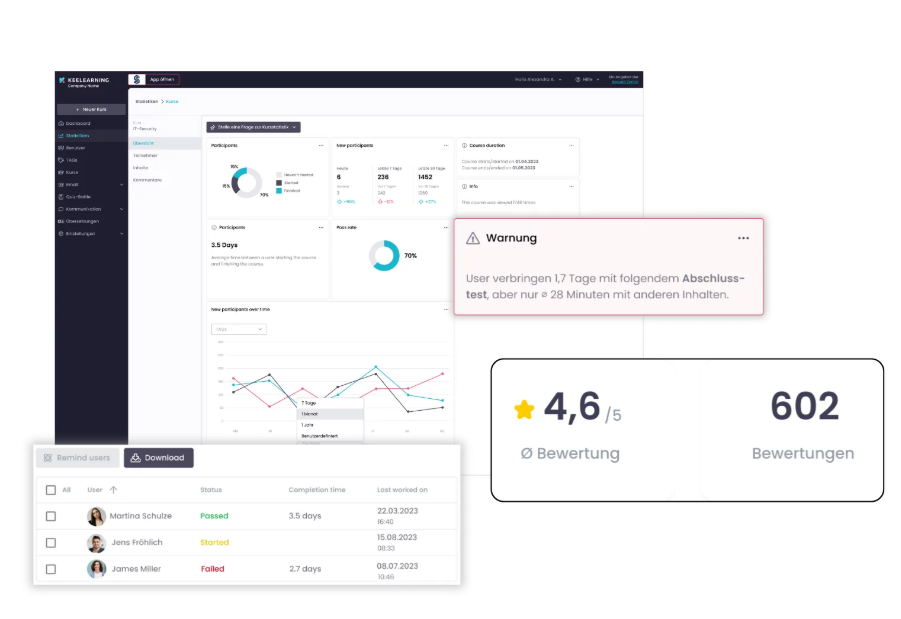
Measure not only participation but also impact: e.g., problem-solving times, knowledge utilization, or employee feedback. Use these insights to continuously improve formats.
When using an e-learning tool, you can also extract hard statistics from the Analytics and Reporting Dashboard.
Using collaborative learning strategically
When employees share their knowledge, reflect together, and learn from one another, not only does greater learning success emerge, but also genuine participation and team commitment. The decisive factor here is the right technological support, which makes collaboration simple and integrates learning seamlessly into everyday work.
With keelearning, you implement collaborative learning purposefully: from peer-learning formats to joint knowledge management to interactive learning paths that actively involve employees.
👉 Discover how keelearning takes your L&D to a new level – and make learning in the company jointly effective.
Table of Contents
Ready for training that works?
Get to know keelearning in a personal demo – no obligation and tailored to your needs.
Share
Lorem ipsum dolor sit amet, consectetur adipiscing elit. Suspendisse varius enim in eros elementum tristique. Duis cursus, mi quis viverra ornare, eros dolor interdum nulla, ut commodo diam libero vitae erat. Aenean faucibus nibh et justo cursus id rutrum lorem imperdiet. Nunc ut sem vitae risus tristique posuere.





The learning platform for businesses looking to make their training simple, mobile, and accessible to all – with no IT overhead.